
Many in NSW wish that someone would dismiss the NSW Government! A number of Government members have been scrutinised in the media as a reuslt of the ICAC investigation into corrupt behaviours at Wollongong Council. The recommendation to dismiss Wollongong City Council was accepted, and Council has been sacked. (See here). They include Joe Tripodi, and Member for Wollongong, Noreen Hay. While not formally investigated, the relationships between the NSW Labor Party and developers has highlighted a number Government members who have, or have had, potential conflicts of interest. These, at least, have not been declared, nor has there been any apparent attempt to avoid or mitigate them.
There are wider issue here, with individuals and "interest groups" gaining access to the Premier and Ministers by buying lunch/dinner meetings with them. The guise is as a "fundraiser" for the ALP. That is, money buys access to government! It includes developers, the hotel industry (AHA), Clubs NSW, and gambling interests. One wonders what "return on investment" they have in mind.(?)
It would be timely to remind ALL of our state politicians that possible and actual corruption must be eliminated, and confilcts of interest avoided. Fortunately ICAC runs training sessions. There is one scheduled for 5 March on Corruption Prevention for Managers, although it is too late for them to register now.
ICAC should be invited to present compulsory training for ALL NSW Parliamentarians - MLA's and MLC's - and their Parliamentary staff. The voters of NSW reasonably expectat that they will know about, and take active measures to avoid, both corruption and conflicts of interest. Anything less represents reprehensible conduct. Ignorance is no excuse.
What will Premier Morris Iemma do - my prediction is that he'll do nothing! Unfortunately that will only erode not only confidence in the NSW Government, but the foundations of our democracy.
John
Tuesday, March 04, 2008
Wollongong Council Sacked
NSW Local Government Minister Paul Lynch has sought, and been granted, the dismissal of Wollongong City Council from NSW Governor, Marie Bashir.
Wollongong Councillors, staff, former staff and developers have been the subject of an ICAC investigation.
Mr Lynch said:
It is right that Wollongong City Council be dismissed - ICAC might yet recommend pursuit of criminal charges against some of those involved. An administrative team will take over, and elections for Wollongong Council will not be held this year. Administration will continue for another four years.
John
Wollongong Councillors, staff, former staff and developers have been the subject of an ICAC investigation.
Mr Lynch said:
"Sacking councils is absolutely the last I want to do but when you've got no
option, you've got no option."
It is right that Wollongong City Council be dismissed - ICAC might yet recommend pursuit of criminal charges against some of those involved. An administrative team will take over, and elections for Wollongong Council will not be held this year. Administration will continue for another four years.
John


Friday, February 29, 2008
NSW Government Sacks Coucil for Incompetency
NSW Local Government Minister Paul Lynch has sacked the Port Macquarie-Hastings Council and appointed an administrator, who will run Council's affairs for the next four years.
Minister Lynch acted on the recommendation of NSW Public Inquiry Commissioner Frank Willan. The Minister further indicated that there appeared to be incompetence, but not corruption.
Given the NSW Government's apparent incompetence at managing projects (T-Card, Cross City Tunnel, Hospitals/Health, etc) and the apparent inability of its Premier and Ministers to avoid conflicts of interest concerning development, there is considerable irony in the decision.
I wonder whether, if he had the powers, Paul Lynch would sack the very government of which he is a member!
John
Minister Lynch acted on the recommendation of NSW Public Inquiry Commissioner Frank Willan. The Minister further indicated that there appeared to be incompetence, but not corruption.
Given the NSW Government's apparent incompetence at managing projects (T-Card, Cross City Tunnel, Hospitals/Health, etc) and the apparent inability of its Premier and Ministers to avoid conflicts of interest concerning development, there is considerable irony in the decision.
I wonder whether, if he had the powers, Paul Lynch would sack the very government of which he is a member!
John
Monday, February 25, 2008
NSW Labor Set To Supernova
The NSW Labor Government is reeling under ever-increasing revelations of corruption at an ICAC inquiry into the relationships among developers, Wollongong Council, and the NSW Government. There are also press reports of possibly corrupt appointment of Labor "mates" and developer donation to political parties.
There is a real risk to our democracy in the way the NSW Government, its Premier and Ministers appear to do business: those with money to donate, get access to Ministers who make decisions. That level of access apparently does not come cheaply; and some donors might well expect a favourable decision after meeting. These erode our democracy; and increase the likelihood and perception of corruption, and benefit only those closely involved.
But there are other problems, too.
John
There is a real risk to our democracy in the way the NSW Government, its Premier and Ministers appear to do business: those with money to donate, get access to Ministers who make decisions. That level of access apparently does not come cheaply; and some donors might well expect a favourable decision after meeting. These erode our democracy; and increase the likelihood and perception of corruption, and benefit only those closely involved.
But there are other problems, too.
- Project Management is almost non-existent, leading to waste of taxpayer money.
- The proposed sale of electricity retail, supply and to lease power station corporations can only lead to higher prices for consumers. The Owen Report was strangled into recommending the sale with a brief to ensure NSW's AAA credit rating. It is being vehemently opposed by unions, employees and others, who cite the lack of benefits to the people of NSW, and the expected large increases in prices.
- Hospitals, and the NSW Health system generally, lurch from one crisis to the next. Much of the problem stems from chronic underfunding, cost-shifting and incompetence.
- Over the last 10 years, successive Police Ministers have sought to exercise greater control over the functioning of the Police Force - something that goes against the principle of the Separation of Powers.
John
Friday, February 22, 2008
NSW Government Unable to Manage Projects
The list of projects bungled by the NSW Labor Government continues to grow. The list includes projects for/at:
What makes a successful project? In my opinion a successful project satisfies the following criteria:
There appears to have been little or none of the above activities undertaken by Morris Iemma's Labor Government. In the current political climate that has developed over the last 10 years, it is also highly likely that each successive Minister/Premier has has a personal say in what they want, which might be at adds with what the real needs of the people of NSW.
The various Ministers and Premier must be accountable to the NSW Parliament, and in some cases accept responsibility, for failed projects that have wasted NSW taxpayers' money.
John
- Royal North Shore Hospital (RNS)
- The Cross City Tunnel Project (disadvantage to public road users/underwriting private project with public money)
- The Lane Cove Tunnel Project (disadvantage to public road users/underwriting private project with public money)
- Orange Hospital Project: indeed health management, in general, seems to lack the investment needed.
- The T-Card (transport) Project, now cancelled
What makes a successful project? In my opinion a successful project satisfies the following criteria:
- all stakeholders are consulted, and feed back sought, before and during the project.
- the customer is satisfied.
- the system works as intended.
- the project is finished on time.
- the project is completed satisfactorily on budget.
There appears to have been little or none of the above activities undertaken by Morris Iemma's Labor Government. In the current political climate that has developed over the last 10 years, it is also highly likely that each successive Minister/Premier has has a personal say in what they want, which might be at adds with what the real needs of the people of NSW.
The various Ministers and Premier must be accountable to the NSW Parliament, and in some cases accept responsibility, for failed projects that have wasted NSW taxpayers' money.
John
Question Time Not About Accountability
Yesterday, in a fit of political pique about not having Question Time as part of the new Friday sittings of Federal Parliament, Joe Hockey said:
Yet a study of Question Time under the former Coalition Government of John Howard by Parameswary Rasiah, University of Western Australia, in 2006 found that
Friday is a new sitting day - there is NO LOSS of existing Question Time, and the Opposition is unsure if it will use the day for its designated purpose - to raise matters of importance to members' constituents: voters who seem unimportant to the Coalition.
Under these circumstances, Joe Hockey's words reek of high hypocracy!
It might well be only media attention and reporting that is maintaining any semblance of accountability and responsibility. They MUST resist any and all criticism from the offices of our political leaders that is aimed at inhibiting "bad news" stories.
Many would agree that similar tactics are used in State Parliament Question Times. Governments, Federal and State, Coalition and Labor, have repeatedly and persistently eroded our democracy, driven by self-interest. It is time for a change in the way Parliamentary Question Time is run.
John
"We (the Liberal/National Party Coalition) stand for accountability, we
stand for transparency"
Yet a study of Question Time under the former Coalition Government of John Howard by Parameswary Rasiah, University of Western Australia, in 2006 found that
"accountability is a highly unlikely outcome of Question Time"given that the (Coalition) government used "Dorothy Dixers" for itself, evasion, changing the subject (usually to abuse Opposition members) and a Speaker who retains membership of, and favouritism towards, the Government. Conversely, it is also probably true that the then (Labor) Opposition asked too many questions aimed merely at political point-scoring.
Friday is a new sitting day - there is NO LOSS of existing Question Time, and the Opposition is unsure if it will use the day for its designated purpose - to raise matters of importance to members' constituents: voters who seem unimportant to the Coalition.
Under these circumstances, Joe Hockey's words reek of high hypocracy!
It might well be only media attention and reporting that is maintaining any semblance of accountability and responsibility. They MUST resist any and all criticism from the offices of our political leaders that is aimed at inhibiting "bad news" stories.
Many would agree that similar tactics are used in State Parliament Question Times. Governments, Federal and State, Coalition and Labor, have repeatedly and persistently eroded our democracy, driven by self-interest. It is time for a change in the way Parliamentary Question Time is run.
John
Tuesday, February 19, 2008
Libs Try Dumping Workchoices
The Liberal Party has today said that it it will no longer support AWA's, the iconic centre of John Howard's WorkChoices. It has been THE primary instrument used to offer workers lower wages, with fewer conditions, and with a requirement of unspecified "reasonable overtime" with no penaly rate.
 Opposition Leader Brendan Nelson left it to his Deputy, Julie Bishop, to front the media. Today's news carried the lowest ever "approval rating" of just 9%. Dr Nelson and Mrs Bishop had argued in and out of Parliament for the retention of AWA's, even after Labor introduced legislation to wind back the effects of WorkChoices.
 Opposition Leader Brendan Nelson left it to his Deputy, Julie Bishop, to front the media. Today's news carried the lowest ever "approval rating" of just 9%. Dr Nelson and Mrs Bishop had argued in and out of Parliament for the retention of AWA's, even after Labor introduced legislation to wind back the effects of WorkChoices.
Politically, WorkChoices has been dead from first moments of last year's election loss by the Liberal Party. Even now they want to have existing or new AWA's to have a 5 year term - not the 2 years proposed in Labor's legislation. It is a sop to big business; an attempt to have one last word on WorkChoices, before the Liberal Party tries to forget its ignominious past. But, for this Parliamentary term, at least, every Liberal Member will be tainted with, and taunted by, "WorkChoices". Julie Bishop has indicated that if it is not accepted, they will still approve Labor's legislation.
It is the second issue this week where emboldened Liberal Party members have tried to distance themselves from the defeat. The ABC aired a "documentary" in which senior Liberal Party members lined up to eagerly say "I told John Howard it was time to go". By implication they lay all the blame for defeat at Howard's feet, and none at their own. They included Senator Nick Minchin, Tony Abbott, Alexander Downer and Peter Costello.
They might well be trying a "makeover" - it could a a very long time before it works. It might only work with new leadership: leadership untainted by WorkChoices and meek subservience to John Howard.
John
Sunday, February 17, 2008
Abbott - The I Team

Tony Abbott must think there's an 'I' in team. What else could one conclusde after his individual "look-at-me" media statements and interviews this week.
First there were HIS statements about the Parliamentary motion of apology to the Stolen Generation. Even in Fairfax media today (Sunday) he is quoted as saying that the apology "was not going to make any practical difference to their lives" . This denies any beneficial effect that psychological healing and a more positive outlook might have. He goes on to question whether any benefits that bipartisan membership of a group could have on a program to help Indigenous communities in the NT. Perhaps he is driven because this relates his his portfolio as a Shadow Minister, but it seems to carry the whiff of sour grapes at having been politically railroaded by Kevin Rudd's unexpected offer from within Parliament. The Opposition should have responded with "we are interested, but the Prime Minister has made this offer without consulting us, and we want to know more." but were railroaded by a piece of smart politics.
On Friday, he made sure that the media knew HE took a $90,000 pay cut after losing his position as a Minister after the election.; why shouldn't he get a pay rise of up to 7%! (as he did last year) This weekend, it was reported that workers from QANTAS Valet Parking have been made redundant, and will be offered the same positions on AWA's, with a $15,00 pay cut! Tony Abbott doesn't like his own cut in pay, but fully supports the retention of AWA's, and their effect of lowering other people's income.
I tlooks like Tony Abbott's media releases are more about ... 'I'-Team Tony Abbott.
John
Wednesday, February 13, 2008
Sorry - A Mixture of Responses
The text of the Australian Parliament's motion of "sorry" to Indigenous Australians can be found here.
Many people, of all backgrounds and communities found the apology an emotional moment: there were tears of joy; tears, too, of remembrance; some frowns, and many, many smiles.
Present in Parliament were Gough Whitlam, Malcolm Fraser, Paul Keating and Bob Hawke - all the living former Prime Ministers. John Howard would not attend to say "sorry", having refused to do so as Prime Minister.
Bringing Them Home, a report into the stolen generation, recommended that 26 May be set aside as a National Sorry Day. (see the site of the National Sorry Day Committee) There are many "days" set aside to remember past events, celebrate events, or to raise awarenes of, usually, health-related matters.
Many people, of all backgrounds and communities found the apology an emotional moment: there were tears of joy; tears, too, of remembrance; some frowns, and many, many smiles.
Present in Parliament were Gough Whitlam, Malcolm Fraser, Paul Keating and Bob Hawke - all the living former Prime Ministers. John Howard would not attend to say "sorry", having refused to do so as Prime Minister.
Bringing Them Home, a report into the stolen generation, recommended that 26 May be set aside as a National Sorry Day. (see the site of the National Sorry Day Committee) There are many "days" set aside to remember past events, celebrate events, or to raise awarenes of, usually, health-related matters.
Others stood and turned their backs as soon as Opposition leader Brendan Nelson stood. The right to disagree, though, does not condone bad manners. Some booed when he mentioned that child abuse still occurs within Indigenous communities. (it also occurs in the wider community) Others are agitating for monetary compensation, and money for communities.
The hope that yesterday's apology brings will only bear fruit if Indigenous leaders, and thier communities, work with governments and their Councils to do what is right for individuals and their community. Alcohol, petrol-sniffing, disconnction from their heritage, and violence will be best stopped from within, and by, communities. Great things can come for individuals and communities when they work together. That is the hope that is what yesterday's apology brings.
Some "activists" were keen to push for monetary "compensation", but reparation can be in kind: it can be in the form of cooperative action with, and for, communities.
The apology was made in good faith by, and on behalf of, the Parliament of Australia. Many Australians agree with its sentiments. Many Indigenous people accepted it with good grace. Others should do so, too.

John
Sorry Tugs the Heartstrings

SORRY
The Parliament and Government of Australia today said "sorry" to aboriginal people for pain and suffering caused by the actions of past people and past Government actions.
The full text appears below.
Today we honour the Indigenous peoples of this land, the oldest continuing cultures in human history.
We reflect on their past mistreatment.
We reflect in particular on the mistreatment of those who were Stolen Generations – this blemished chapter in our nation’s history.
The time has now come for the nation to turn a new page in Australia’s history by righting the wrongs of the past and so moving forward with confidence to the future.
We apologise for the laws and policies of successive Parliaments and governments that have inflicted profound grief, suffering and loss on these our fellow Australians.
We apologise especially for the removal of Aboriginal and Torres Strait Islander children from their families, their communities and their country.
For the pain, suffering and hurt of these Stolen Generations, their descendants and for their families left behind, we say sorry.
To the mothers and the fathers, the brothers and the sisters, for the breaking up of families and communities, we say sorry.
And for the indignity and degradation thus inflicted on a proud people and a proud culture, we say sorry.
We the Parliament of Australia respectfully request that this apology be received in the spirit in which it is offered as part of the healing of the nation.
For the future we take heart; resolving that this new page in the history of our great continent can now be written.
We today take this first step by acknowledging the past and laying claim to a future that embraces all Australians.
A future where this Parliament resolves that the injustices of the past must never, never happen again.
A future where we harness the determination of all Australians, Indigenous and non-Indigenous, to close the gap that lies between us in life expectancy, educational achievement and economic opportunity.
A future where we embrace the possibility of new solutions to enduring problems where old approaches have failed.
A future based on mutual respect, mutual resolve and mutual responsibility.
A future where all Australians, whatever their origins, are truly equal partners, with equal opportunities and with an equal stake in shaping the next chapter in the history of this great country, Australia.
John
Comments on the apology can be found here.
Sunday, February 10, 2008
The Politics of Saying Sorry
The Australian Parliament resumes this week and, on Wednesday 13-Feb-08, it will affirm a motion of sorry to the Stolen Generation. The motion will be an expression of sympathy and acknowledgement of the pain felt by many families after the forced removal of their children.
John Howard steadfastly refuses to attend Parlaiment for the motion - his former MP's probably won't miss him, as they begin to think for themselves, albeit with considerable division.
Kevin Rudd's team is still working on the exact wording, but he has consulted with Brendan Nelson and Aboriginal representatives.
Coalition MP's, long used to John Howard telling what and how to think, have been a rabble. Some, like Julie Bishop, have revereted to "What would John Howard have told me?" Others, like Malcolm Turnbull and Senator Bill Heffernan, believe the proposed apology is overdue, have abandoned their Howard straitjackets, and have been actively lobbying their colleagues.
The Coalition has indicated that some of its MP's and Senators, including Tony abbott, will make statements questioning the term "stolen generation" and stating the good that forced removal of children did. (?) It means the apology is not unanimous and hearfelt by all MP's and Senators - there is a big "But ..." from the Coalition. For the Coalition, at least, "sorry" seems to be the hardest word. Along with unity.
Worthwhile Links:
John
John Howard steadfastly refuses to attend Parlaiment for the motion - his former MP's probably won't miss him, as they begin to think for themselves, albeit with considerable division.
Kevin Rudd's team is still working on the exact wording, but he has consulted with Brendan Nelson and Aboriginal representatives.
Coalition MP's, long used to John Howard telling what and how to think, have been a rabble. Some, like Julie Bishop, have revereted to "What would John Howard have told me?" Others, like Malcolm Turnbull and Senator Bill Heffernan, believe the proposed apology is overdue, have abandoned their Howard straitjackets, and have been actively lobbying their colleagues.
The Coalition has indicated that some of its MP's and Senators, including Tony abbott, will make statements questioning the term "stolen generation" and stating the good that forced removal of children did. (?) It means the apology is not unanimous and hearfelt by all MP's and Senators - there is a big "But ..." from the Coalition. For the Coalition, at least, "sorry" seems to be the hardest word. Along with unity.
Worthwhile Links:
- Bringing Them Home
- Schools NSW
- Australian Indigenous Peoples
- Trinity College (WA) - has some personal stories
- ABC - Personal Stories of Some from the Stolen Generation
John
Thursday, February 07, 2008
Banks Screwing Customers
The 'big four' Australian banks - Westpac, National, Commonwealth and St George - have all lifted their interest rates again, after the Reserve Bank lifted rates by 0.25%. That was the eleventh rise since May 2002. The banks have also unilaterally increased rates during January.
They blamed the sub-prime lending market problems in the US. But, their home loan rates are noticeably higher than non-bank lenders (eg Wizard, Aussie, etc) that have to borrow more of their funds from the troubled US market. The banks are clearly profiteering.

Best advice - find another lender - Credit union, super funds, Aussie, Wizard ...
but do your homework, first.
John
They blamed the sub-prime lending market problems in the US. But, their home loan rates are noticeably higher than non-bank lenders (eg Wizard, Aussie, etc) that have to borrow more of their funds from the troubled US market. The banks are clearly profiteering.

Best advice - find another lender - Credit union, super funds, Aussie, Wizard ...
but do your homework, first.
John
Sunday, February 03, 2008
Costa 'Right' - But Wrong for NSW

Michael Costa, member of NSW Labor Party "right' faction, and Treasurer in the NSW Labor Government might not be the right person for the people of NSW. (image: www.nsw.gov.au)
His most recent outburst occurred after he was stuck in traffic, after an accident on the F3 freeway north of Sydney. Certainly his criticism of the handling of the incident was scathing. Yes, the RTA does need to look at its processes for diverting traffic after accidents, among other things. I'm not sure he needed to make a public song and dance about it - except to justify his penchant for "public-private" relationships. Those relationships have not always been in the public interests, or made the best or appropriate use of public money. He used his privileged position to gain access to Minister for Roads, and mate, Eric Roozendaal, to complain. He used the media to then use his delay as an argument for building more private tollways, partly with public money, so private companies can profit. He has forgotten that the original stretch of the F3 tollway was built by the NSW government, with public money, for public benefit.
But he is developing a history of arguments that support his short-term tenure as Treasurer and politician, but which are not necessarily in the best interests of the people of NSW. Funding by the Treasurer for health/hospitals, transport, and other government services; and hisspecious arguments for selling NSW electricity infrastructure seem to indicate a politician who acts in his own short-term interests, and the interests of his and his party's "image", rather than one who will act in the best interests of the people of NSW. In the NSW Government, and Parliament, he is not alone. Sadly!
His most recent outburst occurred after he was stuck in traffic, after an accident on the F3 freeway north of Sydney. Certainly his criticism of the handling of the incident was scathing. Yes, the RTA does need to look at its processes for diverting traffic after accidents, among other things. I'm not sure he needed to make a public song and dance about it - except to justify his penchant for "public-private" relationships. Those relationships have not always been in the public interests, or made the best or appropriate use of public money. He used his privileged position to gain access to Minister for Roads, and mate, Eric Roozendaal, to complain. He used the media to then use his delay as an argument for building more private tollways, partly with public money, so private companies can profit. He has forgotten that the original stretch of the F3 tollway was built by the NSW government, with public money, for public benefit.
But he is developing a history of arguments that support his short-term tenure as Treasurer and politician, but which are not necessarily in the best interests of the people of NSW. Funding by the Treasurer for health/hospitals, transport, and other government services; and his
John
Tuesday, January 29, 2008
'Quicky" Inquiry for NSW Health
NSW Health Minister, Reba Meagher (pictured below), has announced the terms of reference for the Special Commission of Inquiry into the delivery of patient care in the NSW Health System. The Inquiry will be run by Peter Garling, SC. He has assisted at other inquiries and led the Inquiry into the accident on the old Pacific Highway near Gosford, where two people were swept to their deaths when a section of the highway was washed away. A media release from the Minister can be found here. 

The Inquiry will be able to summon witnesses and if necessary, compel them to answer or provide documents.
The Inquiry must report by 31 July 2008, and must identify "any systemic or institutional issues" in the delivery of health care by the NSW Health and to recommend any changes to models of patient care. This is a short time-frame for any Inquiry, but the States are under pressure from the Federal Government to improve services or face a federal takeover.
However, some of the systemic or institutional problems arise from the (former) Federal Government's argumentative and belligerent form of federalism. Under that model, states have been burdened with supplying almost all of the cost increases in health above inflation. Consequentially state health systems and hospitals, and NSW's in particular, have been run by economic managers - the focus has been on Area Health Service budgets, to the detriment of services provided by hospitals and allied health professionals.
There has been insufficient federal funding for new doctors, and restrictions on places for federally-funded university courses for nurses. Further compounding the issue is the rate of payments by Medicare, which have been held artificially low by successive federal governments; a lack of political will to tell people that the Medicare levy should rise above 1.5%; the public has not helped by using hospitals as a source of "cheap" (Medicare-funded) alternative to visiting a GP; and restrictions on funding for, and places for specialist training.
Any reforms that occur just at state level will have marginal impact unless and until Federal & State Governments; Doctor Associations and Colleges; Nurses Associations; Allied Health Professionals and bureaucrats can cooperate. That will require monumental changes in attitudes. I don't know if Federal Health Minster Nicola Roxon and Prime Minister Kevin Rudd can achieve that - time will tell.
John
Monday, January 28, 2008
Soeharto Dead
Former Indonesian President Soeharto (Suharto) has died from multiple organ failure aged 86. His family will miss him.
Not missisng him, but still wanting an enquiry, are those affected by his alleged:
While his "strength" as President kept Indonesia together, and that was in Australia's interests, history will likely judge him as a corrupt, abusive dictator. Former Australian Foreign Minister, Alexander Downer, described him as having a "less than desirable human rights record" - diplomatic talk meaning "butcher".
I cannot understand why former Prime Minister Paul Keating - who did little or nothing to stop Soeharto's abuses and corruption - would represent Australia at his funeral. The only diplomatic message is that we are not sending a current or immediate past member of the Australian Government. Australia need not send anybody.
Australia's official (& unofficial) comment should be:
John
Not missisng him, but still wanting an enquiry, are those affected by his alleged:
- human rights abuses in Indonesia, East Timor and (now) West Papua.
- corruption, perhaps amounting to US$35 Billion.
While his "strength" as President kept Indonesia together, and that was in Australia's interests, history will likely judge him as a corrupt, abusive dictator. Former Australian Foreign Minister, Alexander Downer, described him as having a "less than desirable human rights record" - diplomatic talk meaning "butcher".
I cannot understand why former Prime Minister Paul Keating - who did little or nothing to stop Soeharto's abuses and corruption - would represent Australia at his funeral. The only diplomatic message is that we are not sending a current or immediate past member of the Australian Government. Australia need not send anybody.
Australia's official (& unofficial) comment should be:
"Former Indonesian President Soeharto (Suharto) has died from multiple organ failure aged 86. His family will miss him."
John
Monday, January 21, 2008
Kev's 08 Inflation Plan
Kevin Rudd has announced his government's plan to control inflation. The 5 point plan aims to increase the targetted budget surplus from 1% of GDP to 1.5%. However, this is already likely to be achieved in 2007-08 because of increased tax revenue and cuts to Government spending since November's election. Given the overheating in the Australian economy,this is not enough. Reserve Bank Governor Glenn Stevens said, in an 18 January speech, that a
Other aspects of the plan include ways to encourage real personal savings, tackling skills shortages, tackling national infrastructure bottlenecks and helping more people to reenter the workforce.
The budget is the biggest, and best, weapon Treasurer Wayne Swan has to fight inflation - it is tool the previous government was unwilling to use, as it splashed ever-more "middle-class welfare" and tax cuts (from which those with more benefitted more) into an overheating economy.
John
"... less favourable short‑term relationship between economic growth and inflation ... might be experienced for a time. This outcome, were it to occur, would make for a more challenging environment for macroeconomic policy‑makers. It would limit the extent to which monetary policies could respond..." (in 2008)That is, it is more important for fiscal policy (the budget) to be used to control inflation by reducing spending and increasing the expected surplus. The Government needs to aim for a $20 Billion surplus.
Other aspects of the plan include ways to encourage real personal savings, tackling skills shortages, tackling national infrastructure bottlenecks and helping more people to reenter the workforce.
The budget is the biggest, and best, weapon Treasurer Wayne Swan has to fight inflation - it is tool the previous government was unwilling to use, as it splashed ever-more "middle-class welfare" and tax cuts (from which those with more benefitted more) into an overheating economy.
John
Sunday, January 20, 2008
Kim Beazley-From Parliament to Next GG?
 Today's media carry news of the possible appointment of former Labor leader Kim Beazley (pictured Photo: smh.com.au) as Australia's next Governor-General. There seems to be support from senior Labor members, including Cabinet Secretary John Faulkner, Foreign Affairs Minister Stephen Smith and Treasurer Wayne Swan.
During John Howard's term as Prime Minister, the office of Governor-General was subjected to some controversy:
- Archbishop Peter Hollingworth resigned following public disquiet about his handling of allegations of sexual abuse by priests under his control. His appointment was also seen by some as a statement to some groups by Mr Howard that 'Australia is a Christian country whether you like it or not'
- Current G-G Major-General Michael Jeffrey was told to keep a low profile by ex-PM Howard - leaving Mr Howard more photo opportunities for his own political purposes.
Kim Beazley might well make a good Governor-General, but he has only just retired from Parliament, his party has just won government, and his appointment will be seen as political. It is not yet time for him to be appointed as Governor-General.
John
PostScript
Prime Minister Rudd has confirmed that Kim Beazley - nor any existing or former politician - will NOT be the next Governor-General. He said, in a media conference:
"The next Governor-General of Australia will not be a former or serving politician - conservative or Labor. The reason being is, I believe it's an office which is often best
discharged by someone from the broader community."
That agrees with Truepolitik's policy on political appointments.
Monday, January 14, 2008
Extra Health Funding No Swan Song
 Treasurer Wayne Swan (official photo from http://www.aph.gov.au/) has given the States and Territories and extra $150 million to reduce surgical waiting lists. Today's meeting of Federal and State & Territory Treasurers and Health Ministers was a a Labor love-in. Much of the substance of the agreement had been decided before the meeting.
NSW gets $43.3 million - almost the one-third for which it asked. The Federal Government is also looking at requests that the States have more freedom to manage the funding. This will be a two-edged sword for the States: Yes, there will be greater freedom and less spent on administration to satisfy the Federal Government, but it also means that State Premiers, Treasurers and Health Ministers must be more accountable to the people they claim to represent.
$150 million will, hopefully, make some measurable impact on hospital waiting lists. But more is needed: more than a decade of costs increasing faster than inflation; tightly-controlled Medicare rebates and restricted funding of public hospitals by both States and the Federal Government meant that there needs to be significant increases in new and upgraded facilities.
The hospital system needs the following
- more beds - in Emergency Departments and in wards
- more doctors: Emergency Dept, surgical, physicians
- more nurses
- more hospital infrastructure and equipment.
- more time for scheduled surgery.
John
Tuesday, January 08, 2008
Cricket Caught Out
The second cricket test against India at the SCG 2-6 Jan 2008 has finished. The book show Australia won. But the last two days' media headlines have been all about controversy.
Poor umpiring decisions benefited Australia more than India. Sledging appears to have become more personal, and Australia complained about allegedly racist remarks from Harbhajan Singh towards Andrew Symonds. Harbhajan was subsequently suspended for 3 matched by match referee Mike Proctor in a hearing held after the match.
At the post-match interview, Indian captain, Anil Kumble, said "I think only one team was playing with the spirit of the game..." So exactly what IS "the spirit of the game"? The Preamble to the Laws of Cricket state:
It seems to me that there were players on both sides who showed disrespect for umpiring decisions, who disputed decisions, who showed disrespect for members of the other team, who appealed knowing the batsman was not out (mostly caught off the pads facing a spin bowler), and who were not honest when they knew they were out. I have previously umpired at local and district representative levels, and I have seen players not 'walk' when caught at first slip, but I can't recall it happening much in test cricket . It happened in this test match.
Australian cricketers have generally behaved worse, but allegations of racism against Harbhajan would the worst incident.
The management of both the Indian and Australian Cricket teams, along with captains Ricky Ponting and Anil Kumble must meet and discuss how they will play the remaining tests within the spirit of the game. That is, without personally derogatory or inappropriate comments, and with honesty. Australia might have won the match, but cricket, and Australian cricket in particular, has been the loser. Captains also need to be held accountable, by the ICC, for the extreme actions of their players - just read the the first paragraph of the Preamble!
John
Poor umpiring decisions benefited Australia more than India. Sledging appears to have become more personal, and Australia complained about allegedly racist remarks from Harbhajan Singh towards Andrew Symonds. Harbhajan was subsequently suspended for 3 matched by match referee Mike Proctor in a hearing held after the match.
At the post-match interview, Indian captain, Anil Kumble, said "I think only one team was playing with the spirit of the game..." So exactly what IS "the spirit of the game"? The Preamble to the Laws of Cricket state:
The Preamble goes on to say that:"Cricket is a game that owes much of its unique appeal to the fact that it should be played not only within its Laws but also within the Spirit of the Game. Any action which is seen to abuse this spirit of fair play rests with the captains."
The Spirit of the Game involves RESPECT for:
• Your opponents
• Your own captain and team
• The role of the umpires
• The game’s traditional values (of behaviour and honesty)
5. It is against the Spirit of the Game:
• To dispute an umpire’s decision by word, action or gesture
• To direct abusive language towards an opponent or umpire
• To indulge in cheating or any sharp practice, for instance:
(a) to appeal knowing the batsman is not out
(b) to advance towards an umpire in an aggressive manner when appealing
(c) to seek to distract an opponent either verbally or by harassment with persistent
clapping or unnecessary noise under the guise of enthusiasm and motivation of one’s own side
It seems to me that there were players on both sides who showed disrespect for umpiring decisions, who disputed decisions, who showed disrespect for members of the other team, who appealed knowing the batsman was not out (mostly caught off the pads facing a spin bowler), and who were not honest when they knew they were out. I have previously umpired at local and district representative levels, and I have seen players not 'walk' when caught at first slip, but I can't recall it happening much in test cricket . It happened in this test match.
Australian cricketers have generally behaved worse, but allegations of racism against Harbhajan would the worst incident.
The management of both the Indian and Australian Cricket teams, along with captains Ricky Ponting and Anil Kumble must meet and discuss how they will play the remaining tests within the spirit of the game. That is, without personally derogatory or inappropriate comments, and with honesty. Australia might have won the match, but cricket, and Australian cricket in particular, has been the loser. Captains also need to be held accountable, by the ICC, for the extreme actions of their players - just read the the first paragraph of the Preamble!
John
Friday, January 04, 2008
Costa Spins Electricty Sale
I have previously expressed an opinion about the sale of electricity assets and business by the NSW Government.
Yesterday, Treasurer Micheal Costa continued his and Premier Iemma's media campaign to justify the political decision. An article appeared in the Sydney Morning Herald, and can be viewed here. An analysis of his comments is below.
The statements and arguments he makes reek simply of politics, and there are significant questions that need to be asked of him.
He states that “Professor Tony Owen said … it would cost the Government $15 billion to build … new baseload generators, maintain the … electricity business and (upgrade) existing power stations”. What he didn’t say is that his proposal will shift these costs to the private sector, which will (ultimately) recoup them from higher prices to us consumers.
He further uses emotional blackmail to argue that the $15 billion would mean a reduction in health, education or police spending. His argument is: ‘Do you want electricity, or hospitals?’ – an argument that is not valid. He doesn’t say that it is perfectly responsible for governments to borrow to build long-term infrastructure that lasts for generations. Indeed, there is a strong argument that future generations should contribute to the cost of infrastructure from which they benefit. That occurs when governments borrow to invest in infrastructure. In this respect, Mr Costa has been disingenuous towards the people of NSW.
Mr Costa asserts that spending on this infrastructure would lead to the “loss of our triple-A credit rating”, but presents no evidence that this would be so. Further, is the objective of the NSW Treasurer to responsibly fund services for the people of NSW, or is it to preserve a credit rating. Every non-politician in NSW would argue that Governments exist to provide services to the people.
Mr Costa’s argument that the drought is responsible for price rises of up to 17% in Victoria are only a half-truth. Certainly the Victorian Government has said that “the drought has limited hydro-electricity production, driving up energy costs.” (ABC ) Neither that statement, nor Mr Costa’s, provide evidence that the costs justify a 17% increase. The drought has limited power from hydro-electricity stations, so there is less electricity in the grid. The price rises could be partly due to profiting from demand for reduced supply.
Mr Costa tells us that the Government is “guaranteeing the job of every worker in their present locations” – he did NOT add the “but only for 3 years” part. Again, he has told us a half-truth.
He later launches into an attack on opponents with “the xenophobic undercurrent of claims of a foreign takeover”. This is typical political strategy:- if you don’t like the message, shoot the messenger.
In short, Mr Costa’s article contains omissions, half-truths, ill-directed political objectives and “shoot the messenger” arguments. That is, it is full of political spin.
The people of NSW don't need, or want, that. They want politicians who will act in the best interests of the people of NSW.
John
Yesterday, Treasurer Micheal Costa continued his and Premier Iemma's media campaign to justify the political decision. An article appeared in the Sydney Morning Herald, and can be viewed here. An analysis of his comments is below.
The statements and arguments he makes reek simply of politics, and there are significant questions that need to be asked of him.
He states that “Professor Tony Owen said … it would cost the Government $15 billion to build … new baseload generators, maintain the … electricity business and (upgrade) existing power stations”. What he didn’t say is that his proposal will shift these costs to the private sector, which will (ultimately) recoup them from higher prices to us consumers.
He further uses emotional blackmail to argue that the $15 billion would mean a reduction in health, education or police spending. His argument is: ‘Do you want electricity, or hospitals?’ – an argument that is not valid. He doesn’t say that it is perfectly responsible for governments to borrow to build long-term infrastructure that lasts for generations. Indeed, there is a strong argument that future generations should contribute to the cost of infrastructure from which they benefit. That occurs when governments borrow to invest in infrastructure. In this respect, Mr Costa has been disingenuous towards the people of NSW.
Mr Costa asserts that spending on this infrastructure would lead to the “loss of our triple-A credit rating”, but presents no evidence that this would be so. Further, is the objective of the NSW Treasurer to responsibly fund services for the people of NSW, or is it to preserve a credit rating. Every non-politician in NSW would argue that Governments exist to provide services to the people.
Mr Costa’s argument that the drought is responsible for price rises of up to 17% in Victoria are only a half-truth. Certainly the Victorian Government has said that “the drought has limited hydro-electricity production, driving up energy costs.” (ABC ) Neither that statement, nor Mr Costa’s, provide evidence that the costs justify a 17% increase. The drought has limited power from hydro-electricity stations, so there is less electricity in the grid. The price rises could be partly due to profiting from demand for reduced supply.
Mr Costa tells us that the Government is “guaranteeing the job of every worker in their present locations” – he did NOT add the “but only for 3 years” part. Again, he has told us a half-truth.
He later launches into an attack on opponents with “the xenophobic undercurrent of claims of a foreign takeover”. This is typical political strategy:- if you don’t like the message, shoot the messenger.
In short, Mr Costa’s article contains omissions, half-truths, ill-directed political objectives and “shoot the messenger” arguments. That is, it is full of political spin.
The people of NSW don't need, or want, that. They want politicians who will act in the best interests of the people of NSW.
John
Tuesday, January 01, 2008
Conroy's Communication Collision
Federal Communications Minister, Stephen Conroy, has announced Federal Government plans to use ISP's for Internet content filtering. Senator Conroy has said it will be mandatory for ISPs to filter pornography and "inappropriate material" to houses and schools. He claims the scheme will protect children from pornography and violence.
He said he would not apologise to people who argued that Internet regulation was "like going down the Chinese road" (of heavily restricted, state-controlled filtering). Here, Senator Conroy is thumbing his nose at those who argue for 'freedom of speech'. No-one of fair mind would argue against protecting children, but governments, both Liberal and Labor, have a poor record on openness. Consider how the former Liberal Coalition government, and the current NSW Labor government used FOI laws to minimise accountability.
Senator Conroy went on to say, "If people equate freedom of speech with watching child pornography, then the Rudd-Labor Government is going to disagree." Here, he is simply disparaging anyone who argues against him, consigning all and sundry to the depravity of paedophiles. Mandatory filtering might be one of a number of appropriate methods of protection, but Senator Conroy is trying to stifle debate about them.
The OpenNet Initiative (ONI) gives its mission as:"to identify and document Internet filtering and surveillance, and to promote and inform wider public dialogue about such practices."
This is what they said about Australia, BEFORE the current government's announcement:
The BBC quotes an ONI report that list 25 countries that apply Internet filtering:Azerbaijan, Bahrain, Burma/Myanmar, China, Ethiopia, India, Iran, Jordan, Libya, Morocco, Oman, Pakistan, Saudi Arabia, Singapore, South Korea, Sudan, Syria, Tajikistan, Thailand, Tunisia, Turkmenistan, UAE, Uzbekistan, Vietnam and Yemen.
It would seem Australia is to join that list. Freedoms? Protection? Or another step in the race to become a police state? Senator Conroy does not want press comments and editorials - his comments made that clear. Just how will the media respond?
John
He said he would not apologise to people who argued that Internet regulation was "like going down the Chinese road" (of heavily restricted, state-controlled filtering). Here, Senator Conroy is thumbing his nose at those who argue for 'freedom of speech'. No-one of fair mind would argue against protecting children, but governments, both Liberal and Labor, have a poor record on openness. Consider how the former Liberal Coalition government, and the current NSW Labor government used FOI laws to minimise accountability.
Senator Conroy went on to say, "If people equate freedom of speech with watching child pornography, then the Rudd-Labor Government is going to disagree." Here, he is simply disparaging anyone who argues against him, consigning all and sundry to the depravity of paedophiles. Mandatory filtering might be one of a number of appropriate methods of protection, but Senator Conroy is trying to stifle debate about them.
The OpenNet Initiative (ONI) gives its mission as:"to identify and document Internet filtering and surveillance, and to promote and inform wider public dialogue about such practices."
This is what they said about Australia, BEFORE the current government's announcement:
"Australia maintains some of the most restrictive Internet policies of any Western nation, while its neighbor, New Zealand, is less rigorous in its Internet regulation. Without any explicit protection of free speech in the constitution, the Australian government has used its 'communications power' delineated in the constitution to regulate ..."
The BBC quotes an ONI report that list 25 countries that apply Internet filtering:Azerbaijan, Bahrain, Burma/Myanmar, China, Ethiopia, India, Iran, Jordan, Libya, Morocco, Oman, Pakistan, Saudi Arabia, Singapore, South Korea, Sudan, Syria, Tajikistan, Thailand, Tunisia, Turkmenistan, UAE, Uzbekistan, Vietnam and Yemen.
It would seem Australia is to join that list. Freedoms? Protection? Or another step in the race to become a police state? Senator Conroy does not want press comments and editorials - his comments made that clear. Just how will the media respond?
John
Sunday, December 30, 2007
Benazir Bhutto's Legacy
Benazir Bhutto: 1953 - 2007
Benazir Bhutto has been buried before sunset, in the family mausoleum, next to her father.
She persisted with her drive to democracy for Pakistan, and was assassinated on 27-Dec-2007, after a rally before the scheduled elections.
Benazir Bhutto was first elected as Prime Minister in 1988; and again in 2003. It is likely that the charges of corruption brought by Pakistan Presidents Khan and Leghari. Khan had disagreements with both Bhutto and the PPP; and with the military, whose legislative power he sought to restrict. Leghari, also from Bhutto's Pakistan People Party is reported by Wikipedia to have succumbed to blackmail in bringing charges against Benazir Bhutto.
Benazir Bhutto was a woman in a man's world. Muslim societies do not easily tolerate women in positions of power: her family's strong political background and her family name undoubtedly helped.
Benazir Bhutto could become Pakistan's martyr to democracy. Maybe!
President Musharraf was, until recently, both head of the military, and President. The Military will not easily give up its power and political influence. Those who riot after Bhutto's death do themselves and their country no good. It is very likely that elections scheduled for 8-January-2008 will be cancelled, a state of emergency declared, and both Musharraf and the military will retain political control.
If they do, Pakistan will remain a divided nation. One group will have money, and/or political influence or power; the rest will have nothing, as they have now.
Benazir Bhutto's legacy could be that millions have hope of democracy, and a fairer system of government. If they don't get it, Pakistan could well become unstable, with pockets of rebellion, in a country that has somewhere near 100 nuclear weapons. Frightening!
John

Benazir Bhutto has been buried before sunset, in the family mausoleum, next to her father.
She persisted with her drive to democracy for Pakistan, and was assassinated on 27-Dec-2007, after a rally before the scheduled elections.
Benazir Bhutto was first elected as Prime Minister in 1988; and again in 2003. It is likely that the charges of corruption brought by Pakistan Presidents Khan and Leghari. Khan had disagreements with both Bhutto and the PPP; and with the military, whose legislative power he sought to restrict. Leghari, also from Bhutto's Pakistan People Party is reported by Wikipedia to have succumbed to blackmail in bringing charges against Benazir Bhutto.
Benazir Bhutto was a woman in a man's world. Muslim societies do not easily tolerate women in positions of power: her family's strong political background and her family name undoubtedly helped.
Benazir Bhutto could become Pakistan's martyr to democracy. Maybe!
President Musharraf was, until recently, both head of the military, and President. The Military will not easily give up its power and political influence. Those who riot after Bhutto's death do themselves and their country no good. It is very likely that elections scheduled for 8-January-2008 will be cancelled, a state of emergency declared, and both Musharraf and the military will retain political control.
If they do, Pakistan will remain a divided nation. One group will have money, and/or political influence or power; the rest will have nothing, as they have now.
Benazir Bhutto's legacy could be that millions have hope of democracy, and a fairer system of government. If they don't get it, Pakistan could well become unstable, with pockets of rebellion, in a country that has somewhere near 100 nuclear weapons. Frightening!
John
Sunday, December 23, 2007
Merry Christmas 2007
What is Christmas about? Is it about presents, family, holidays away, frantic mad shopping, idiocy and death on our roads? All of these happen at Christmas time, or XMAS, as it is sometimes abbreviated. The 'X' in XMAS comes from the Greek letter χ (chi), which starts the Greek word for Christ.
Christmas is a secular festivity, and a religious one. Christians celebrate the birth of Christ, in a manger, at Bethlehem. Other religions celebrate the birth of their gods and prophets, but the celebration of Chrtistmas in our society has also become a social celebration.
 As we celebrate Christmas, many people will attend church ceremonies. Religious leaders will publish a Christmas message. My hope is that people will give to those less fortunate, spend time with family and friends, build understanding with other people, and that people reflect on the meaning of Christ's message in today's world. By doing so, may they realise the need for all people to work together for peace, hope for tolerance, and act justly.
Merry Christmas, ... and Happy New Year.
John
Christmas is a secular festivity, and a religious one. Christians celebrate the birth of Christ, in a manger, at Bethlehem. Other religions celebrate the birth of their gods and prophets, but the celebration of Chrtistmas in our society has also become a social celebration.
 As we celebrate Christmas, many people will attend church ceremonies. Religious leaders will publish a Christmas message. My hope is that people will give to those less fortunate, spend time with family and friends, build understanding with other people, and that people reflect on the meaning of Christ's message in today's world. By doing so, may they realise the need for all people to work together for peace, hope for tolerance, and act justly.
Merry Christmas, ... and Happy New Year.
John
PS some will say that the above was full of idealism, but without idealism, we condemn ourselves to accept the otherwise unacceptable.
Friday, December 21, 2007
Haneef: Court Rejects Andrews' Appeal
The full bench of the Federal Court of Australia has upheld a previous court's decision to grant Dr Haneef his work visa. The previous Immigration Minister, Kevin Andrews, had made a political decision that Dr Haneef was not of good character, because his second cousins in Britain had his (British) mobile phone card, and had allegedly been involved in terrorist activity.
 (Photo: http://www.smh.com.au/) The political decision came after the courts had dismissed charges of aiding terrorists against Dr Haneef. The "character test" was applied with Minsterial discretion on the basis of the alleged actions of his cousins, at a time when Dr Haneef was in Australia.
Previous comments about "the Haneef case" can be found here (there are several posts in July 2007)
Mr Andrews, as then Minister, appealed. The Federal Court disagreed with him on matters of law.
Dr Haneef, on a pilgrimage to Mecca, can return to Australia to work, if he wants. The Queensland Government has said that he will be welcome to apply, if he satisfies visa and doctor registration procedures.
 (Photo: http://www.smh.com.au/) The political decision came after the courts had dismissed charges of aiding terrorists against Dr Haneef. The "character test" was applied with Minsterial discretion on the basis of the alleged actions of his cousins, at a time when Dr Haneef was in Australia.
Previous comments about "the Haneef case" can be found here (there are several posts in July 2007)
Mr Andrews, as then Minister, appealed. The Federal Court disagreed with him on matters of law.
Dr Haneef, on a pilgrimage to Mecca, can return to Australia to work, if he wants. The Queensland Government has said that he will be welcome to apply, if he satisfies visa and doctor registration procedures.
There are serious questions that we need to ask about the process used, and motives of, previous Minister Andrews. Among them are:
- what were his political motives?
- was he acting under instructions from former Prime Minister Howard?
- was there any breach of the "separation of powers"?
- was AFP Commisioner Mick Keelty acting in the interests of, and with advice from, the government?
Our democracy needs to be robust, and we need to be able to trust governments, and Ministers. I'm not sure we could trust the previous Coalition Government.
John
Monday, December 17, 2007
Tax Cuts Inflationary
The ABC and other media are reporting that Access Economics has warned the (new) Federal Labor Government that its promised tax cuts will be inflationary. During the election campaign, John Howard's Coalition Government promised $34 Billion in personal tax cuts; Kevin Rudd promised $31 Billion. In the midst of the election campaingn the Reserve Bank of Australia raised interest rates by 25 basis points (0.25%), an unprecedented intervention during an election campaign.
In October, I reported that the promised tax cuts would be inflationary. I stated:
Treasurer Wayne Swan has a difficult task to deliver ANY tax cuts, and still find sufficient extra savings to fund them, and increase his budget surplus from 1% to a more responsible 1.5% of GDP.
John
In October, I reported that the promised tax cuts would be inflationary. I stated:
Now, it seems that Access Economics has confirmed that view. They also point out that finding cuts might be politically unpopular, and mentioned "middle-class welfare" as one area where cuts could be made. "Middle class welfare" is a term often used to describe Federal Government houndouts that are not means tested, and provided to people who are not in need of the money. It is a policy that was heavily used by the Coalition Government to win votes. Cutting it will be fraught with political danger, even if it is tapered and means-tested."(tax cuts) by themselves, they will be inflationary. The economy will have to produce nearly $50 Billion of EXTRA GDP. It is already groaning under the strain of other pressures such as the US sub-prime mortgage market, rising oil prices, rising food prices, and rising prices of other goods ... We need responsible economic management, not inflationary tax cuts."
Treasurer Wayne Swan has a difficult task to deliver ANY tax cuts, and still find sufficient extra savings to fund them, and increase his budget surplus from 1% to a more responsible 1.5% of GDP.
John
Saturday, December 15, 2007
Political Climate Change At Bali
The US has agreed to a compromise plan to start talks on a new climate change protocol, to take effect after obligations under the existing Kyoto Protocol expire in 2012.
Every other represented country, or group such as the European Union (EU) agreed to the compromise plan. The 190 members of the UN Framework Convention on Climate Change (UNFCCC) agreed to the plan after almost 2 weeks of negotiations, and after the return of UN Secretary-General Ban Ki-moon. He returned to Bali to urge, with diplomatically plain language, recalcitrant countries to agree to the 'Bali Roadmap' for the good of humanity. I'm sure the US will soon find economic, trade, and foreign policy reasons to justify their change of heart.
There was certainly a sense of desperation as Kevin Rudd told his team, and Penny Wong, in particular, to do "whatever it takes" negotiate a settlement. Climate change is a priority.
So, what next for Australia? I believe we need to look at the following, from a national perspective:
In business speak, we need to undertake a process called Business Process Engineering - we need to fundamentally change what and how we do things.
John
Every other represented country, or group such as the European Union (EU) agreed to the compromise plan. The 190 members of the UN Framework Convention on Climate Change (UNFCCC) agreed to the plan after almost 2 weeks of negotiations, and after the return of UN Secretary-General Ban Ki-moon. He returned to Bali to urge, with diplomatically plain language, recalcitrant countries to agree to the 'Bali Roadmap' for the good of humanity. I'm sure the US will soon find economic, trade, and foreign policy reasons to justify their change of heart.
There was certainly a sense of desperation as Kevin Rudd told his team, and Penny Wong, in particular, to do "whatever it takes" negotiate a settlement. Climate change is a priority.
So, what next for Australia? I believe we need to look at the following, from a national perspective:
- reduce "base load" electricity demand, and hence our reliance on coal. The term "clean coal" is deceptive - coal is dirty, and it does pollute.
- reduce unnecessary lighting in office buildings at night
- reduce the use of "off-peak" (night-time) electric hot water systems, and install more solar hot water systems, with gas backup.
- increase the use of wind farms
- increase the use of solar electricity generation on houses, and large business buildings, especially where buildings have air conditioning installed
- mandate national building design codes that increase the use of passive heating and cooling (verandahs, awnings & blinds, building aspect, insulation and construction materials)
All of this will involve significant changes to aspects of our economy, and our individual and collective thinking - we will need to increase investments in some areas of our economy and reduce it in other areas.
It won't be easy, and we do need our political leaders to take short-term hard decisions for the longer term benefit, while still being mindful of the social effects That is, after all, what we pay them to do.In business speak, we need to undertake a process called Business Process Engineering - we need to fundamentally change what and how we do things.
John
Sunday, December 09, 2007
Libs a Half-Nelson Basket Case
As John Howard enjoys his new-found, but unwanted, leisure time, the Federal Liberal Party is in leadership turmoil. It has been revealed that Malcolm Turnbull was unhappy about the leadership election, with now two members who have since lost their seats voting, and two senators whose planes were delayed not allowed to vote. Brendan Nelson won the leadership by just three votes.
The reality is that with John Howard gone, and Peter Costello declining, there is a lack of clear leadership within the Liberal Party - hence the divided vote. One of the consequences of John Howard's dominance and "strong leadership" is that, apart from the anointment on Peter Costello, the leadership skills of other members was suppressed and its development stopped.
While both men are aspirational leaders, neither yet has the charisma AND political skills to lead the Liberal Party to a future victory. It is unlikely that Brendan Nelson has the ability to charm teh electorate to lead the Liberal Party to an election win in the foreseeable future; and Malcolm Turnbull is seen as too ill-disciplined and prone to "shoot his mouth off". The Federal Liberal Party has similar leadership woes to those that Labor had after Paul Keating lost, and left.
There are not many leadership options yet, apart from Brendan Nelson or Malcolm Turnbull. We might well have the simmering divisions can that turn a political party into a "basket case". That is something that NSW State Party Director Geoff Selig warned against, but probably can't yet stop.
John
The reality is that with John Howard gone, and Peter Costello declining, there is a lack of clear leadership within the Liberal Party - hence the divided vote. One of the consequences of John Howard's dominance and "strong leadership" is that, apart from the anointment on Peter Costello, the leadership skills of other members was suppressed and its development stopped.
While both men are aspirational leaders, neither yet has the charisma AND political skills to lead the Liberal Party to a future victory. It is unlikely that Brendan Nelson has the ability to charm teh electorate to lead the Liberal Party to an election win in the foreseeable future; and Malcolm Turnbull is seen as too ill-disciplined and prone to "shoot his mouth off". The Federal Liberal Party has similar leadership woes to those that Labor had after Paul Keating lost, and left.
There are not many leadership options yet, apart from Brendan Nelson or Malcolm Turnbull. We might well have the simmering divisions can that turn a political party into a "basket case". That is something that NSW State Party Director Geoff Selig warned against, but probably can't yet stop.
John
Saturday, December 08, 2007
Crean Speaks on Climate Change
Simon Crean is in Bali for Trade talks - appropriate, given that is his portfolio. But he seems to have spoken out of turn on climate change. He has more experience than to do that. Mr Crean said that developing countries, including China and India, must commit to much tougher emission targets before Australia would commit to a post-Kyoto Agreement on Climate Change.
Worse, Mr Crean then went on to say that Australia would not commit to any binding targets till next year - at least till after the report on the economics of climate change is handed to the Federal Government.
Already Prime Minister Rudd has said that what Mr Crean suggested about developing countries is not the Government's policy. It would seem that Trade Minister Crean has spoken out on an area that is not his portfolio, and made suggestions that are not (officially) government policy. Nevertheless, climate change will have an effect on trade, and it is appropriate for the Trade Minister to make comments about climate change - they just need to be consistent with government policy.
There is a danger that Kevin Rudd will seek to assert HIS "strong leadership". The problem with that is that "strong leadership" often seeks to dominate by stifling discussion, even among colleagues. This is the type of control used by former Prime Minister John Howard - to his ultimate detriment, the detriment of the Liberal Party, and to the detriment of good policy for the Australian people.
Kevin Rudd will certainly need to discuss the problem with Simon Crean. Ministers must not become compliant servants of the Prime Minister. They need clear direction, a deep understanding of Government Policy, and need to learn to be trusted to speak on matters that affect their portfolio.
John
Worse, Mr Crean then went on to say that Australia would not commit to any binding targets till next year - at least till after the report on the economics of climate change is handed to the Federal Government.
Already Prime Minister Rudd has said that what Mr Crean suggested about developing countries is not the Government's policy. It would seem that Trade Minister Crean has spoken out on an area that is not his portfolio, and made suggestions that are not (officially) government policy. Nevertheless, climate change will have an effect on trade, and it is appropriate for the Trade Minister to make comments about climate change - they just need to be consistent with government policy.
There is a danger that Kevin Rudd will seek to assert HIS "strong leadership". The problem with that is that "strong leadership" often seeks to dominate by stifling discussion, even among colleagues. This is the type of control used by former Prime Minister John Howard - to his ultimate detriment, the detriment of the Liberal Party, and to the detriment of good policy for the Australian people.
Kevin Rudd will certainly need to discuss the problem with Simon Crean. Ministers must not become compliant servants of the Prime Minister. They need clear direction, a deep understanding of Government Policy, and need to learn to be trusted to speak on matters that affect their portfolio.
John
Tuesday, December 04, 2007
T-Card Project A Failure
T-Card is supposed to be the new integrated, electronic ticketing system to cover public transport on buses, trains and ferries. Last Month (Nov-07), the State Government gave notice of its intention to cancel the contract, unless the company (ERG) can demonstrate a working system within twenty days.
On 3 December 2007, ERG gave a statement to the Australian Stock Exchange, saying it was "well placed to implement the system on a wide scale by 2009". ERG claims to have implemented similar systems in Melbourne, Singapore, Rome and San Francisco. The question then is, "why invent a new system, when it already has successful existing systems?"
On 9 November the NSW Transport Minister, John Watkins, said "Enough is enough. ... This has been a very frustrating project." The system was supposed to be working before the 2000 Sydney Olympic Games.
What makes a successful project? In my opinion a successful project satisfies the following criteria:
Good Project Management requires that, at each stage of the project, a review is conducted to determine whether it is worthwhile continuing. It seems to me that ERG has been more interested in continuing the project, hoping to retrieve the golden egg of taxpayer money, even when technical and other difficulties seem to have indicated otherwise.
It would seem to be a project worthy of cancellation. In future the NSW Government, through the Dept of Commerce, should oversee projects, and insist on having representatives on the project oversight committee, and on project teams.
John
On 3 December 2007, ERG gave a statement to the Australian Stock Exchange, saying it was "well placed to implement the system on a wide scale by 2009". ERG claims to have implemented similar systems in Melbourne, Singapore, Rome and San Francisco. The question then is, "why invent a new system, when it already has successful existing systems?"
On 9 November the NSW Transport Minister, John Watkins, said "Enough is enough. ... This has been a very frustrating project." The system was supposed to be working before the 2000 Sydney Olympic Games.
What makes a successful project? In my opinion a successful project satisfies the following criteria:
- the customer is satisfied. Clearly this is not the case, with the customer, the NSW Government preparing to stop the project.
- the system works as intended. Again, this is clearly not the case.
- the project is finished on time. 2007 is well past the expected completion in early 2000. The Auditor-General's office in its Report to Parliament 2006 Volume 5 p338 stated "We are not aware of any further remedy for delays. (in the T-Card project)"
- the project is completed satisfactorily on budget. While NSW has spent $64 million, it has not made all the payments, becasue the contract included penalties for non-completion of milestones. Since it seems unlikely a working system won't be forthcoming for nealy another two years, and at unknown cost, there are good aruments for terminating the project.
Good Project Management requires that, at each stage of the project, a review is conducted to determine whether it is worthwhile continuing. It seems to me that ERG has been more interested in continuing the project, hoping to retrieve the golden egg of taxpayer money, even when technical and other difficulties seem to have indicated otherwise.
It would seem to be a project worthy of cancellation. In future the NSW Government, through the Dept of Commerce, should oversee projects, and insist on having representatives on the project oversight committee, and on project teams.
John
Monday, December 03, 2007
Koperberg Steps Into A Straight Right
NSW Labor Minister Phil Koperberg has stepped aside pending results from a preliminary police investigation into acts of domestic violence allegedly committed 20 years ago. The time is irrelevent, and it should be investigated. Premier Morris Iemma's hand was forced when two people called hi soffice to speak to him about it. at that point, Mr Iemma aasked his Director-General to refer the matter to the police. Appropriately, he would not name the two people who called his office.
But what of the underlying politics? Who has the knives out for Mr Koperberg? The allegations surfaced in 2006 before the March 07 state election, and were denied then. Paul Gibson, then a Labor MP, had a 10 year affair with the former Mrs Katherine Koperberg, and there appears to be bad blood between the two men. After the election in March, allegations about Paul Gibson' salleged violence towards Sandra Nori surfaced. He was denied a ministry. Police later dropped the investigation for lack of viable evidence.
Now, Paul Gibson seems to have copy of Mrs Koperberg's affidavit alleging assault on her and her daughter. So do some reporters.
The issue has become both political and the subject of a police investigation. It would seem there is some dirty politics, but violence should never be tolerated - just ask Paul Gibson.
John
But what of the underlying politics? Who has the knives out for Mr Koperberg? The allegations surfaced in 2006 before the March 07 state election, and were denied then. Paul Gibson, then a Labor MP, had a 10 year affair with the former Mrs Katherine Koperberg, and there appears to be bad blood between the two men. After the election in March, allegations about Paul Gibson' salleged violence towards Sandra Nori surfaced. He was denied a ministry. Police later dropped the investigation for lack of viable evidence.
Now, Paul Gibson seems to have copy of Mrs Koperberg's affidavit alleging assault on her and her daughter. So do some reporters.
The issue has become both political and the subject of a police investigation. It would seem there is some dirty politics, but violence should never be tolerated - just ask Paul Gibson.
John
Sunday, December 02, 2007
Education A Learning Curve for Labor
As Julia Gillard prepares Labor's Education agenda for the two Cabinet meetings before Christmas, she should pause and consider some of the concepts proposed.
Access to a computer at school for every Year 9 -12 student is readily achievable, but it will also need to be considered in conjunction with the broadband for schools policy. The Federal Government will need to meet with state governments, Catholic Education Offices, and independent schools to ensure that computers provided are appropriate.
The trades in schools policy requires much more work, and probably needs rethinking. This is especially true for regional areas where it is unlikely that each school would have sufficient interested and committed students or resources to create classes in multiple trades areas.
A more practical solution might be to provide incentives for schools to allow students to enrol in courses at TAFE, where that is available. In most states, there is a program which allows students to study TAFE courses as part of their Yr 11 and Yr 12 studies. Classes often include students from several schools, and they gain from the expertise of TAFE teachers, and from the usually, better resources provided by TAFE . Delivery by TAFE would be more cost-efficient, and provide a wider range of trades for study than could be provided by placing one trade class at every school.
While providing resources directly to schools is electorally and superficially popular, ultimately, using existing TAFE systems would provide better outcomes for the economy as well, because more students could be trained in more trades areas more efficiently, using qualified trades teachers who know their industry.
John
Access to a computer at school for every Year 9 -12 student is readily achievable, but it will also need to be considered in conjunction with the broadband for schools policy. The Federal Government will need to meet with state governments, Catholic Education Offices, and independent schools to ensure that computers provided are appropriate.
The trades in schools policy requires much more work, and probably needs rethinking. This is especially true for regional areas where it is unlikely that each school would have sufficient interested and committed students or resources to create classes in multiple trades areas.
A more practical solution might be to provide incentives for schools to allow students to enrol in courses at TAFE, where that is available. In most states, there is a program which allows students to study TAFE courses as part of their Yr 11 and Yr 12 studies. Classes often include students from several schools, and they gain from the expertise of TAFE teachers, and from the usually, better resources provided by TAFE . Delivery by TAFE would be more cost-efficient, and provide a wider range of trades for study than could be provided by placing one trade class at every school.
While providing resources directly to schools is electorally and superficially popular, ultimately, using existing TAFE systems would provide better outcomes for the economy as well, because more students could be trained in more trades areas more efficiently, using qualified trades teachers who know their industry.
John
Friday, November 30, 2007
Training Labor's New Ministers
Having been elected to government on 24 Nov 2007, Kevin Rudd has announced his new ministers. It includes two members who have previously been Ministers: John Faulkner and Simon Crean. Warren Snowden and Nick Sherry have had experience as Parliamentary Secretaries. The full list will shortly appear at the Australian Parliament House website . Three members of Cabinet have less than six years Parliamentary experience: Penny Wong (5); Peter Garrett (3); and Tony Burke (3).
While Kevin Rudd will have appointed minders to help his new team, it is important that neither they, nor Kevin Rudd, rule his ministers in the same way that John Howard did. Such close control would increase the risk that Kevin Rudd's Ministers will be as stifled, robotic, and mere 'appendages of power', as were many of John Howard's ministers.
It is likely that some will make mistakes. Unless the mistakes are serious, new Ministers need to be able to learn and be guided, without the heavy handed "I'll tell you what to say, when, where, how and to whom you will say it" approach that John Howard used.
That is, Ministers need a "structured workplace learning" program, similar to those used in trade and vocational training. This will help ensure that Ministers grow into their job and develop Ministerial skills that are both specific to their portfolios, and which could be applied elsewhere.
Such a program will not only help to create more effective ministers, but also ministers that more open and responsive. That could only benefit everyone, and strengthen our democracy, and develop trust from the media and voters.
John
While Kevin Rudd will have appointed minders to help his new team, it is important that neither they, nor Kevin Rudd, rule his ministers in the same way that John Howard did. Such close control would increase the risk that Kevin Rudd's Ministers will be as stifled, robotic, and mere 'appendages of power', as were many of John Howard's ministers.
It is likely that some will make mistakes. Unless the mistakes are serious, new Ministers need to be able to learn and be guided, without the heavy handed "I'll tell you what to say, when, where, how and to whom you will say it" approach that John Howard used.
That is, Ministers need a "structured workplace learning" program, similar to those used in trade and vocational training. This will help ensure that Ministers grow into their job and develop Ministerial skills that are both specific to their portfolios, and which could be applied elsewhere.
Such a program will not only help to create more effective ministers, but also ministers that more open and responsive. That could only benefit everyone, and strengthen our democracy, and develop trust from the media and voters.
John
Wednesday, November 28, 2007
Difficult Choices for Libs
Today, the contest for the Liberal Party leadership narrowed after Tony Abbott withdrew because he would not get enough votes. The leadership will be contested by Malcolm Turnbull and Brendan Nelson.
 Turnbull seems to have won a number of vox populi polls in the media. Whether that is reflected in the party room is another matter. Of the two, Malcolm Turnbull is the better speaker, and more words of substance seem to come from him than ever came from Brendan Nelson.
 Andrew Robb, the former Federal Party Director, has less experience in Parliament, but more political nous that Chris Pyne or Julie Bishop, and might well have a steadying influence on Malcolm Turnbull.
Post Script - Thursday
 Turnbull seems to have won a number of vox populi polls in the media. Whether that is reflected in the party room is another matter. Of the two, Malcolm Turnbull is the better speaker, and more words of substance seem to come from him than ever came from Brendan Nelson.
Of the contenders for the Deputy Leader, SA's Chris Pyne and WA's Julie Bishop are the most discussed in the media. While he is a qualified in Law, Chris Pyne seems to only ever have worked for the Liberal Party, both before entereing Parliament in 1993, and as a Member of Parliament. This almost total lack of real-world work might well hinder his ambitionis. Julie Bishop has worked as a solicitor and barrister for almost 20 years, had experience on the board of SBS and in an institute for managers.
 Andrew Robb, the former Federal Party Director, has less experience in Parliament, but more political nous that Chris Pyne or Julie Bishop, and might well have a steadying influence on Malcolm Turnbull.
The Liberal Party will elect its new leaders tomorrow (Thursday). My prediction, based on CV's and Ministerial & political competence is: Malcolm Turnbull & Andrew Robb.
What I think the Liberal Party will do? I think they will elect Malcolm Turnbull as Leader, with Andrew Robb as Deputy; Chris Pyne and Julie Bishop might withdraw, leaving Robb unopposed. They'll be rewarded with shadow Ministries with increased standing in the Party Room.
John
Post Script - Thursday
Today the Federal Liberal Party elected Brendan Nelson as its leader; Julie Bishop as Deputy Leader. Given Brendan Nelson's somewhat taciturn manner, Julie Bishop will provide some "personality" to the leadership. She should be able to hold her own in Parliament, given her prior performances.
John
Tuesday, November 27, 2007
Fixing Public Hospitals
One of Kevin Rudd’s election platforms was to negotiate better funding for public health with the states. The requirement is better health administration. His Kevin07 wesite says:
“Under Labor's Plan, in order to access funds, the States will be required to sign up to achieving specified health outcomes, such as:· Reducing avoidable hospitalisations and readmissions to hospital;· Reducing non-urgent accident and emergency presentations;· Reducing waiting times for those people who require essential hospital services such as elective surgery; and· Providing more appropriate non-acute care for older Australians.”
There are some specific problems that we, individually, collectively and politically must face. There has developed over some years a culture of division between the states and commonwealth, based largely on political differences and prejudices. This has lead to:
“Under Labor's Plan, in order to access funds, the States will be required to sign up to achieving specified health outcomes, such as:· Reducing avoidable hospitalisations and readmissions to hospital;· Reducing non-urgent accident and emergency presentations;· Reducing waiting times for those people who require essential hospital services such as elective surgery; and· Providing more appropriate non-acute care for older Australians.”
There are some specific problems that we, individually, collectively and politically must face. There has developed over some years a culture of division between the states and commonwealth, based largely on political differences and prejudices. This has lead to:
- cost-and-blame-shifting, as each tries to limit the $ exposure for “its” responsibilities.
A reduction in the proportion of GDP provided by the commonwealth for public health care provided by the states. At the same time, the Commonwealth was happy to provide funds to support private health insurance (companies)and private hospitals. - The costs of providing health care have been increasing at a rate faster than inflation and economic growth, and the states have borne the brunt of extra funding required for public hospitals
- Increasing “gaps” in health care, resulting from the previous two conditions.
Recent events in NSW at RNS emergency dept and RPA maternity are examples of how health care and its administration has been driven by budget constraints and not health planning and funding.
Kevin Rudd is offering an extra $2 billion over 4 years. Economically he can’t just pump money into the economy – he will need to restrain spending or eliminate unnecessary government spending to maintain an economically neutral position. The Commonwealth and States, and NSW in particular, will need to develop significant restructure plans for health administration, to be implemented over 5 years. Its likely effects will include significant changes in personnel, business process reengineering to change the way and culture of doing things, and higher levels of political accountability and responsibility.
The effects of such changes will take at least ten years to be fully felt. This requires planning well beyond the 4-years of budget forward estimates, but it must be done.
John
Liberal Woes Self-Inflicted
The Liberal Party implosion since it lost the election last Saturday is not surprising.
The leadership void and lack of clear direction has occurred because: John Howard ruled “his” government with an iron fist; he used his own staff to monitor and micro-manage his Ministers and Parliamentary Secretaries; he used some government members to ensure MP’s and Senators complied with his wishes. In their compliance, Liberal Ministers, MP’s and Senators have served the interests of the Liberal Party – a service Peter Costello mentioned when declining to be nominated as “leader of the Opposition”
The leadership void and lack of clear direction has occurred because: John Howard ruled “his” government with an iron fist; he used his own staff to monitor and micro-manage his Ministers and Parliamentary Secretaries; he used some government members to ensure MP’s and Senators complied with his wishes. In their compliance, Liberal Ministers, MP’s and Senators have served the interests of the Liberal Party – a service Peter Costello mentioned when declining to be nominated as “leader of the Opposition”
 Such “strong”, overbearing and dominating leadership stifles proper discussion, suppresses opposing views, inhibits the desirable effects of conscience & ethical principles, and stifles leadership qualities. One measure of the dominance exerted by John Howard is the number of his former Senators and Ministers now saying that they “told him (John Howard) to go”; Peter Costello has declined the leadership, having been “promised” the Prime Ministership which is now not there for him. They can say this because John Howard is no longer their leader, and he's not in Parliament any more.
Senior Liberal Party members are also now saying they should “dump WorkChoices” and support ratifying the Kyoto Protocol, and its attendant environmental targets. This is probably the correct policy direction, but it will seem to smack of hypocrisy, given their previous vigorous public defence of John Howard's position.
It also put members of the Coalition in the position of defending John Howard, even if they had misgivings. Here the list extends to WorkChoices; funding of public education, public hospitals and health; “children overboard”; attack dogs on the wharves; the Tampa affair, where Australia clearly breached its obligations under International Maritime Law; and immigration detention centres & “the Pacific Solution” to refugees. The drive to make unemployment at less than 4%, with rising inflation from the volume of money pumped into the economy hardly smacks of responsible economic management that would “keep interest rates at the lowest levels for 30 years”.
John Howard, driven by his own obsession with power, has done much to tear apart the fabric and principles of the Liberal Party, and poisoned the political careers of many Liberal Party MP’s and Senators.
John
Sunday, November 25, 2007
Rudd as PM But Who'll Lead the Lost?
Australia has a new Prime Minister-elect. Kevin Rudd claimed victory after a phone call and concession speech by John Howard. As the first Labor Prime Minister for 11 years, Kevin Rudd has become a hero to his party.
Both leaders have displayed graciousness - they're obviously not in Parliamentary Question Time - and are to be congratulated for that.
John Howard could well lose his seat, Bennelong, which he held since 1974. As the Liberal and National Party, which also lost seats, began preparing for life in opposition, there came another blow. Just hours after ex-Foreign Affairs Minister Alexander Downer was reported saying that "the best thing the Liberal Party can do now is get behind Peter Costello as leader", Peter Costello issued a statement saying he will NOT contest the leadership of the Liberal Party! Dear Alexander, did you not call Peter first?! Peter Costello is the Liberal Party's best performer in Parliament. There are few other worthwhile candidates: they will probably have to choose between Brendan Nelson (of marginal competence as a Minister), Malcolm Turnbull (known to leak Cabinet discussions, and waver under political pressure), or 'mad-monk' Tony Abbott.
Even if he retains his seat - a big IF - John Howard will not lead the Liberal Party. Peter Costello's decision not to lead them will leave the Liberal Party floundering, probably for some time, simply because there is no-one with the same political strength to replace John Howard. That was crushed by Howard's iron fist in the Cabinet and Party Room. Disunity and internal mistrust could be the characteristics of the new opposition. None will want to face Parliamentary questions on on WorkChoices, Iraq, Health and education funding, Federal-State relationships, or the Nationalist principles John Howard wanted.
John
Both leaders have displayed graciousness - they're obviously not in Parliamentary Question Time - and are to be congratulated for that.
John Howard could well lose his seat, Bennelong, which he held since 1974. As the Liberal and National Party, which also lost seats, began preparing for life in opposition, there came another blow. Just hours after ex-Foreign Affairs Minister Alexander Downer was reported saying that "the best thing the Liberal Party can do now is get behind Peter Costello as leader", Peter Costello issued a statement saying he will NOT contest the leadership of the Liberal Party! Dear Alexander, did you not call Peter first?! Peter Costello is the Liberal Party's best performer in Parliament. There are few other worthwhile candidates: they will probably have to choose between Brendan Nelson (of marginal competence as a Minister), Malcolm Turnbull (known to leak Cabinet discussions, and waver under political pressure), or 'mad-monk' Tony Abbott.
Even if he retains his seat - a big IF - John Howard will not lead the Liberal Party. Peter Costello's decision not to lead them will leave the Liberal Party floundering, probably for some time, simply because there is no-one with the same political strength to replace John Howard. That was crushed by Howard's iron fist in the Cabinet and Party Room. Disunity and internal mistrust could be the characteristics of the new opposition. None will want to face Parliamentary questions on on WorkChoices, Iraq, Health and education funding, Federal-State relationships, or the Nationalist principles John Howard wanted.
John
Friday, November 23, 2007
NSW Libs' Right-Wing Attack Lindsay
Five Liberal Party members have used leaflets giving false information about Muslim group supporting the ALP has backfired.
The Muslim groups on the leaflet doesn't exist, and the statements about the ALP are false. Involved in the distribution are at least 5 Liberal Party members and supporters. The most significant members of the group that misrepresented Muslims and the ALP are:
Here, the action has racist and xenophobic undertones, and both Kelly and Chijoff are probably tarnished as part of the racist faction within Right-wing of the NSW Liberal Party. That the matter has been passed from the Electoral Commission to the Federal Police should stop them laughing.
John
The Muslim groups on the leaflet doesn't exist, and the statements about the ALP are false. Involved in the distribution are at least 5 Liberal Party members and supporters. The most significant members of the group that misrepresented Muslims and the ALP are:
- NSW Liberal Party executive member, Jeff Egan
- Retiring Liberal MP Jackie Kelly's husband, Garry Clark
- Greg Chijoff, husband of the Liberal candidate fro Lindsay
Here, the action has racist and xenophobic undertones, and both Kelly and Chijoff are probably tarnished as part of the racist faction within Right-wing of the NSW Liberal Party. That the matter has been passed from the Electoral Commission to the Federal Police should stop them laughing.
John
Wednesday, November 21, 2007
Leaders' To-Do Lists
Kevin Rudd released his top5 "To-Do" list in an interview with The Sun-Herald last weekend.
They were:
- climate change
- education
- health
- broadband
- computers in schools
This gives him the "soft", people-centred tasks. Signing the Kyoto Protocol and setting interim targets is largely symbolic, but allows us to have a greater say at the next round of negotiations in Bali. The Coalition won't sign, and we'll be in the back blocks, left out of key negotiations.
Education, health, fast broadband (especially for regional areas) and computers in schools will appeal to most sections of the community.
John Howard has reacted with:
- strong economy (growth)
- security
- "election promises"
- Takeover of the Murray-Darling Basin
- talking about recognition of Indigenous people in the Constitution
The trouble for Mr Howard is that economic growth is not what is needed, and his election promises, if implemented, will drive inflation for years after he retires. Further, his economic record speaks of WorkChoices, a term he now avoids, but which he did not tell voters about last time.
He gave no detail about further "security" legislation that he wants. (shades of WorkChoices?)
John Howard believes his use of "economic management" will win votes. If voters think about his promises, and the current state of the economy, it could be political poison for him.
John
Sunday, November 18, 2007
Election 2007 Prediction
With the Federal election next Saturday, and many pollsters predicting a Labor landslide, the following is my prediction, based on a combination of Antony Green's Election Predictor at the ABC's Election 2007 site, polls, "history" and "art of prediction" (whatever that is!)
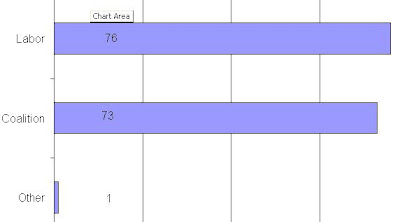
In fact, the predictor suggested Labor 78; Coalition 70; Other 2.
However, I believe there are a few seats that will not conform to the "State-based swing" result: The Prime Minister's seat of Bennelong will possibly be retained, on the back of a "sympathy vote"; the Seat of Dobell will be a 50-50 proposition, as will be Malcolm Turnbull's seat of Wentworth in Eastern Sydney, and the SA seat of Boothby. Eden-Maonaro will be won by the ALP.
Now, we just need to wait and see.
John

In fact, the predictor suggested Labor 78; Coalition 70; Other 2.
However, I believe there are a few seats that will not conform to the "State-based swing" result: The Prime Minister's seat of Bennelong will possibly be retained, on the back of a "sympathy vote"; the Seat of Dobell will be a 50-50 proposition, as will be Malcolm Turnbull's seat of Wentworth in Eastern Sydney, and the SA seat of Boothby. Eden-Maonaro will be won by the ALP.
Now, we just need to wait and see.
John
Thursday, November 15, 2007
Howard vs Labor - the Election Promise Effects
Both major parties have now launched their election campaigns. We've had almost 4 weeks of the unofficial election campaign where travel and living expenses of our politicians have been paid by taxpayers. Many would argue that, ethically, once the election writs have been issued by the Governor-General, political parties should be paying, not the taxpayer.
John Howard, at the Liberal Party launch, promised an extra $9.5Billion to voters. This brings his total to almost $65 Billion.
Kevin Rudd, claiming the economic conservative high ground, promised an extra $2.3Billion at the Labor Party's launch. this brought his total to almost $57Billion.
The possible effects of election spending by the end of 2009 are:
Of course, John Howard could have some "non-core" promises that he won't implement; and Kevin Rudd could increase the amount of budget surplus retained from 1% to 1.5%-2% during the current boom.
John Howard has gone for the "Go for Growth" slogan - the problem is that there is no room for growth without inflation. Both he and Peter Costello are ideologically locked into retaining only 1% of GDP, even as the economy is overheating and creating inflation. Excessive growth is NOT what the economy needs at the moment.
Kevin Rudd has gone for the "New Leadership" slogan. If elected, his leadership will be tested by the economic conditions he inherits. An overheated economy with rising inflation and significant overseas pressures. Increasing the retained budget surplus from 1% to 1.5% will be a challenge.
John
John Howard, at the Liberal Party launch, promised an extra $9.5Billion to voters. This brings his total to almost $65 Billion.
Kevin Rudd, claiming the economic conservative high ground, promised an extra $2.3Billion at the Labor Party's launch. this brought his total to almost $57Billion.
The possible effects of election spending by the end of 2009 are:
- Home Loan Interest Rates under John Howard: 11% - 12%
- Home Loan Interest Rates under Kevin Rudd: 9% - 10%
Of course, John Howard could have some "non-core" promises that he won't implement; and Kevin Rudd could increase the amount of budget surplus retained from 1% to 1.5%-2% during the current boom.
John Howard has gone for the "Go for Growth" slogan - the problem is that there is no room for growth without inflation. Both he and Peter Costello are ideologically locked into retaining only 1% of GDP, even as the economy is overheating and creating inflation. Excessive growth is NOT what the economy needs at the moment.
Kevin Rudd has gone for the "New Leadership" slogan. If elected, his leadership will be tested by the economic conditions he inherits. An overheated economy with rising inflation and significant overseas pressures. Increasing the retained budget surplus from 1% to 1.5% will be a challenge.
John
Wednesday, November 14, 2007
Non-Exclusive Interview - Rudd & Howard Talk
"Mr Howard, thanks for your time. I know you're busy with the election."
"Yes - so much money to give away - baby bonus, tax cuts... And so many Liberal seats to try to keep."
"But won't that be inflationary? Won't the economy suffer?"
"Inflation, schminflation - look, I won't be around next election so it won't matter .... to me at least. That'll be Peter's job, if I win"
"Yes, Mr Rudd, thanks for your time. You've also promised tax cuts."
"Yes, John, but ours aren't inflationary. See, I'm an economic conservative, unlike that economic thug, John Howard. He just throws money around willy-nilly. And it's not even his money."
"But the Reserve Bank says that inflation is likely to be higher till at least 2009, and more interest rate rises are likely. That will affect homeowners with a mortgage."
"John, Janette and I own our own home, so they won't affect us. And they won't affect the rich too much either."
"Me, too".
"Don't either of you care?"
(Howard) "Is that a rich private entity I can give taxpayer money to?"
(Rudd) "Of course the Labor Party cares - we are the caring party."
(Howard) "Any interest rate rises are because of union thugs - it's not my fault. It's not, mum"
John
"Yes - so much money to give away - baby bonus, tax cuts... And so many Liberal seats to try to keep."
"But won't that be inflationary? Won't the economy suffer?"
"Inflation, schminflation - look, I won't be around next election so it won't matter .... to me at least. That'll be Peter's job, if I win"
"Yes, Mr Rudd, thanks for your time. You've also promised tax cuts."
"Yes, John, but ours aren't inflationary. See, I'm an economic conservative, unlike that economic thug, John Howard. He just throws money around willy-nilly. And it's not even his money."
"But the Reserve Bank says that inflation is likely to be higher till at least 2009, and more interest rate rises are likely. That will affect homeowners with a mortgage."
"John, Janette and I own our own home, so they won't affect us. And they won't affect the rich too much either."
"Me, too".
"Don't either of you care?"
(Howard) "Is that a rich private entity I can give taxpayer money to?"
(Rudd) "Of course the Labor Party cares - we are the caring party."
(Howard) "Any interest rate rises are because of union thugs - it's not my fault. It's not, mum"
John
Friday, November 09, 2007
Banks Interest in Greed
Banks have tried to "talk up" the possibility of raising interest rates by more than the 0.25% rise in the rate set by the Reserve Bank, announced on Wednesday.
They claim they have been carrying costs asociated with the troubled sub-prime markets, mostly in the US. The decision to lend money in such markets forms part of a bank's overall business strategy and business decisions are made on that basis.
Let's look at the 2007 profits for the major banks (results reported to Sept-November 2007):
If the business decisions they made are not as profitable, then they need to examine their strategic plans, and redirect their money to customers who will generate a stable return on their investment ... but not increase their loan rates by more than 0.25%.
John
They claim they have been carrying costs asociated with the troubled sub-prime markets, mostly in the US. The decision to lend money in such markets forms part of a bank's overall business strategy and business decisions are made on that basis.
Let's look at the 2007 profits for the major banks (results reported to Sept-November 2007):
"Net profit for the year to September was $1.163 billion, an increase of 11 per
cent over 2006. After adjusting for hedge fund accounting, cash profit was
$1.160 billion, an increase of 13.1 per cent over the previous year."
"3.45 billion, 12 per cent higher than this time last year."
"Macquarie says its profit for the six months to September should be up strongly
on last year's corresponding result of $730 million", and is expecting a record
profit for the current six month period.
"met forecasts with a 20 percent rise in second-half profit, driven by strong
loan growth, and said it targeted revenue growth above the industry average in
its key consumer banking"
"For the 12 months to 30 June 2007, statutory net profit after tax was $4,470 million", a 14 percent increase, and reportedly has less exposure to the US sub-prime market.
- ANZ:
ANZ recorded a record profit of $4.18 Billion, an increase of 13 percent.In the face of record profits and increases of 4-5 times that of inflation, and because they admit they made business decisions that have not made as much profit as regular mortgages and bank fees, and that therefore they need to increase lending rates of existing mortgages by more than 0.25% is, I think, wrong.
If the business decisions they made are not as profitable, then they need to examine their strategic plans, and redirect their money to customers who will generate a stable return on their investment ... but not increase their loan rates by more than 0.25%.
John
Wednesday, November 07, 2007
Interest Rates Up - Howard says 'Sorry'
There were no surprises at all today, when the Reserve Bank announced it has lifted interest rates by 0.25%. The banks and financial institutions will follow suit.
Over the last 3 budgets (2005-2007), John Howard and Peter Costello have pumped about $70 Billion into the Australian economy in personal tax cuts alone. In May 2006, John Howard defended his tax cuts, saying they were not inflationary! He issued another $37 Billion in 2007.
His redistribution of tax money seems to favour those who are wealthier, with households in the top 10% of income taking about 30% of the tax cut money. See here.
A look at the RBA's interest rate rises shows increases in: May 2006, Aug 2006, Nov 2006, Aug 2007, Nov 2007.
The economy, for its part has had to generate an extra $100+ in value of GDP as consumers spent up big. There are only 2 ways it can do this: create more goods and services - difficult in an economy at full capacity - or the increase prices - inflation.
Part of the RBA's statement says:
It is this growth in demand that needs to be managed. The Federal Budget needs to remove more money from the economy to help reduce demand - but that would not be popular in an election year, so political expediency takes precedence. Good economic management doesn't count.
Today, John Howard said "sorry", but 'sorry' doesn't mean "good economic management"
John
Over the last 3 budgets (2005-2007), John Howard and Peter Costello have pumped about $70 Billion into the Australian economy in personal tax cuts alone. In May 2006, John Howard defended his tax cuts, saying they were not inflationary! He issued another $37 Billion in 2007.
His redistribution of tax money seems to favour those who are wealthier, with households in the top 10% of income taking about 30% of the tax cut money. See here.
A look at the RBA's interest rate rises shows increases in: May 2006, Aug 2006, Nov 2006, Aug 2007, Nov 2007.
The economy, for its part has had to generate an extra $100+ in value of GDP as consumers spent up big. There are only 2 ways it can do this: create more goods and services - difficult in an economy at full capacity - or the increase prices - inflation.
Part of the RBA's statement says:
Inflation in Australia has increased. ... During 2007, the pace of growth of
demand and output has also increased.
It is this growth in demand that needs to be managed. The Federal Budget needs to remove more money from the economy to help reduce demand - but that would not be popular in an election year, so political expediency takes precedence. Good economic management doesn't count.
Today, John Howard said "sorry", but 'sorry' doesn't mean "good economic management"
John
Sunday, November 04, 2007
Inflation - it's not my fault says Howard
On Wednesday, we will find out if the Reserve Bank lifts interest rates yet again. It would be the 6th interest rate rise since the last election. John Howard promised voters keep interest rates "at a record 30 year low".
Today, he told the ABC there are some factors that might lead to another interest rate rise: the strength of the economy, which he manages; the growing price of oil, and the drought (which is affecting food prices).
But, as with most political statements, it is what John Howard is NOT telling us that matters. In determining the underlying rate of inflation, the Reserve Bank discounts the effects of items seen as volatile, including the price of oil, and of food.
That leaves John Howard's contribution - the "strength" of an overheating economy; an economy managed by his & Peter Costello's budgets. Within hours, Mr Howard promised to pump an extra $10 Billion into the economy, as he tried to buy votes in the politically important areas of Sydney, Victoria, and south-east Queensland. These are areas with electorates he must retain to continue his (otherwise) unannounced agendas.
There are two elements in the fine print, though: the road/rail funding is targeted till 2020 - 4 government terms away; and it is as though he wants to ensure that inflation continues to grow, whatever the outcome.
Economically responsible - you bet it's not!
John
Today, he told the ABC there are some factors that might lead to another interest rate rise: the strength of the economy, which he manages; the growing price of oil, and the drought (which is affecting food prices).
But, as with most political statements, it is what John Howard is NOT telling us that matters. In determining the underlying rate of inflation, the Reserve Bank discounts the effects of items seen as volatile, including the price of oil, and of food.
That leaves John Howard's contribution - the "strength" of an overheating economy; an economy managed by his & Peter Costello's budgets. Within hours, Mr Howard promised to pump an extra $10 Billion into the economy, as he tried to buy votes in the politically important areas of Sydney, Victoria, and south-east Queensland. These are areas with electorates he must retain to continue his (otherwise) unannounced agendas.
There are two elements in the fine print, though: the road/rail funding is targeted till 2020 - 4 government terms away; and it is as though he wants to ensure that inflation continues to grow, whatever the outcome.
Economically responsible - you bet it's not!
John
Friday, November 02, 2007
Madness, The Monk & The Rock Star

The last few days must have John Howard and Kevin Rudd wishing, praying, that their charges would stop having moments of madness.
Tony Abbott, Minister for Health, has been called "the mad monk". His madness erupted this week, with public abuse of Bernie Banton for (trying to) deliver a petition for PBS support for a drug to treat asbestos-related illness. Mr Banton will die from such an illness, and campaigned with unions to get compensatin from James Hardie.
Then there was the the debacle at Mersey Hospital: the Federal Government was supposed to take control, but somebody forgot to arrange for federal supervision of state doctors, and to solve the problem of not using "Workchoices" on the new emeployees. Workchoices is a particularly sensitive area for the government, and it is desperate to retain seats in Tasmania.
Then, in Victoria with Prime Minister Howard for a "policy launch". John Howard was having such a good time he kept Tony Abbott waiting to return to Canberra for a televised debate with Labor Health spokeswoman, Nicola Roxton. He was overheard saying "that's bullshit" to Roxton's taunt that he could have been on time.
All he could do was "grin and bear it" - and apologise ... often.
Today, a radio shock jock reported Labor's Peter Garrett saying to him that, if elected, Labor would "change everything" - presumably its promises and policies. And the Liberal Party wants to (as a Federal Government) take over Grafton Hospital. They haven't yet solved the (Workchoices) problems at Mersey Hospital.
Madness ... sheer madness!
John
Subscribe to:
Posts (Atom)

 Posts
Posts


