Sunday, May 29, 2011

Minchin–Party Over The People

In an article published by the Sydney Morning Herald yesterday, 28-May-11, Senator Nick Minchin outlines some serious flaws in our party-dominated system. The first clause in the first sentence is:
“As I prepare to retire from 32 years of full-time service to the Liberal Party, …” (18 of those years was as Senator)
Nick Minchin:
worked for the party
It could be said by a retiring Parliamentarian from any major party. Nick Minchin was elected as a Senator to represent the Constitutional interests of South Australia on 1-July-1993. He has been a Senator for 18 years. From 1977 to 1993, he worked for the Liberal Party's Federal Secretariat; he was Deputy Federal Director of the Liberal Party in 1983 and held senior positions in the South Australian Liberal Party. In his public life, and his 18 years in the Senate, Nick Minchin has always worked for the interests of the Liberal Party.
Senator Minchin goes on:
(Party) “success really lies in getting the balance right between Principle and Pragmatism -between the pursuit of good policy and the need to retain popular support”
This is undoubtedly true, and Principle alone rarely leads to good policy. Even when policy is not good, Party Parliamentarians will still vote for the party, because it is in the Party’s interests. This is true of members from all major parties: Labor, Liberal, National; and minor parties like  the Greens. Consider the following:
  • the policy to deliberately breach International Law (the Tampa Affair) – Liberal Party
  • the Pacific Solution – using Nauru to hold asylum seekers, and to leave 1 person alone in detention for more than 2 years, and subject to UN criticism. Nauru is not a signatory to the UN convention on refugees – Liberal Party
  • the (proposed) Malaysian Solution – using Malaysia to take 800 asylum seekers, in exchange for 4000 UN-determined refugees. Malaysia is not a signatory to the UN convention on refugees – Labor Party
  • WorkChoices, a fundamentalist attack on the wages and working conditions on some of the very people the Liberal Party relied on to retain power - Liberal Party
  • Mining tax, which was poorly considered, and effectively gelded by a big-business-funded populism campaign – Labor Party
In each case the party members did vote, or would have voted, for the policy, based solely on their party membership.

This is where Independent Parliamentarians have a significant role to play. As much as the Liberal Party has tried to demonise Tony Windsor and Rob Oakeshott, their role as Independent, non-party-political MP’s in a Federal Parliament with a minority government is invaluable. It makes the government, and to a lesser extent the Opposition, consider a position or compromise that will prevent or ameliorate fundamentalism and extremism. That is something members of the major parties rarely do on their own initiative.

John

Saturday, May 28, 2011

NSW Steps Towards Dictatorship

NSW Liberal Premier Barry O'Farrell is trying to take NSW one step closer to being a dictatorship. He proposes to introduce legislation which will allow a Minister, under his direction, to introduce regulations that will determine the pay and conditions for public servants, including: public service staff; public teachers; nurses; hospital doctors; carers; public transport staff.

The previous State Government introduced legislation (so-called Part3A Planning Laws) that allowed the Planning Minster to introduce ‘regulations’ approving Development Applications above a certain value. The Minster was able to act as Legislature (instead of Parliament), Executive (Minister) and Judiciary. Those ‘regulations’ were used to allow:
  • multiple wind-farms around Crookwell, Lake George and Cullerin, close to people's houses.
  • the development of Barangaroo, which was allowed to bypass City of Sydney planning laws; and environmental clean-up laws.
  • an approved development at Catherine Hill Bay, again contrary to local council planning laws, and contrary to the Minister's own departmental advice. 
  • coal seam gas extraction without reference to other local or state planning, environmental or heritage laws in the Illawarra, Camden, the Hunter Valley. There were/are plans for drills in the Southern Highlands, near Bowral.
Photo: Groomgreens.org
Many believe that "Government-by-Regulation" is wrong, including me. They are wrong because they diminish, or even reduce to zero, the Principle of Separation of Powers: that Parliament, Government and the Judiciary are independent. Especially the Judiciary.
The current State Government made much of undoing the Planning Minister’s ability to introduce such regulations, and returning planning powers to Local Councils, saying that such regulatory powers were wrong.

Now, it seems those same regulatory powers are OK! Mr O’Farrell intends to use the same “regulatory powers” again. Not for planning, but for Industrial Relations. Mr O'Farrell proposes legislation that will allow a Minister to be able to regulate the pay and conditions of public servants. That is, the Minister will introduce a regulation that effectively directs one or more judges of IRC to make a particular decision regarding pay and conditions. This removes the judicial independence from industrial court decisions. This “Government-by-Regulation” is exactly how the various contentious wind-farms were allowed, Barangaroo and coal-seam gas developments were allowed.


While there is no direct enshrinement of the Doctrine of Separation of Powers - that Parliament, Government and the Judiciary are independent - in NSW’s Constitution, it is worth publicly noting that there are long-standing conventions regarding the Separation of Powers in NSW. Queensland’s Joh Bjelke-Petersen was found to have no concept of it during the Fitzgerald Inquiry, and the corruption in the government he led, and the Police Force he controlled, is well documented. This proposed Act will weaken the Separation of Powers in NSW because a Minister will the Legislature, the Executive, and will effectively make judgements on behalf of the Judiciary, who will be required to ‘rubber stamp’ them. Again, this means that one person, under the direction of Mr O’Farrell and any future Premier, will effectively be Legislature, Executive and Judiciary!

Mr O’Farrell’s proposed legislation clearly breeches the Principle of Separation of Powers by action and intent, is unethical, weakens our democracy, and leaves open the opportunity for corruption by this, and future governments. It must be vigorously opposed.

“Government-by-Regulation” was wrong for wind-farms and other large developments, not because they are wind-farms, or large developments, but because “Government-by-Regulation” allowed at least some  inappropriate developments, diminished our democracy, and allowed for possible corruption in future. The same is true for Mr O’Farrell’s “Government-by-Regulation” for industrial relations.

The question for every NSW Parliamentarian is: will he/she be guided by good conscience and the interests of the people and of democracy, or will they let Mr O’Farrell take NSW one step closer to Dictatorship?

Contact as many MLA’s and MLC’s as you can. See http://www.parliament.nsw.gov.au/prod/parlment/members.nsf/V3Home

John

Sunday, May 22, 2011

Gillard Defends Carbon Tax

Julia Gillard has defended the budget, and the proposed carbon tax. Her comments, though, came only at the Victorian Labour Party State Conference.

During her speech she attacked Tony Abbott’s credibility, and his thoughtless right wing agenda. She said:
“We know climate change is real.
We know we must cut carbon pollution.
We know the cheapest, most efficient way to do that is to make big polluters pay.
And we know that when big polluters pay that every cent of that money can be used to help families, protect jobs and fund programs to tackle climate change.
Friends, it’s been said before now but it’s never been truer than of the fight to price carbon:
This isn't a fight between right and left.
It's a fight between right and wrong.”
"We are fighting to price carbon to tackle climate change and to build a clean energy economy which is prepared and strong."
Ms Gillard’s attack on Tony Abbott’s attempt at a climate change populism included:
"We don't have time for politicians and shock jocks who deny the scientific conclusions of NASA and the CSIRO.
We don't have time for made-up figures and shameless fear mongering.
We don't have time to waste on a debate that lacks fact and reason.”
"Our national efforts and energies must be focused...
"We are a nation determined to do our bit to tackle climate change and urgently need to make a start to build the clean energy economy of the future."
The full transcript of Ms Gillard’s speech of 21-May-2011 is at http://www.pm.gov.au/press-office/address-alp-victorian-branch-state-conference-melbourne
It seems to me that these are the types of comment that Ms Gillard, As Prime Minister of Australia, should be making often in the media. She might not like that Tony Abbott is effectively running his negative 2013 election campaign in almost daily press releases, radio interviews with largely conservative media and set-up TV appearances, but they have been effective in raising not only Mr Abbott’s profile, but his approval rating. Many unthinking voters will say he’s doing a good job, simply because they do not see Ms Gillard using the media in the same way, with the same frequency, or countering Abbott’s negativity.

Despite any, and all, governments saying they do not worry about the polls, they do. Their media advisers and their party strategists are all over the polls, and regularly and routinely use “focus groups”.

Tony Abbott does not argue policy deliberately – he doesn’t want any policy scrutinised. His campaign is based almost exclusively on negativity. He does not want public debate, he wants perception of a “good job” because he makes frequent noises. But this is not public debate on policy directions, and Ms Gillard does not help the government by not taking the debate to the media daily. She needs to show some passion, even crankiness at Abbott, during any such media grabs.

John

Sunday, May 15, 2011

2011 Budget

This past week, the Federal Treasurer, Wayne Swan, delivered his budget on Tuesday night. Traditionally, the Leader of the Opposition gives a Budget reply speech. By common agreement among journalists, Tony Abbott gave a pre-election speech.

In his 3rd paragraph he said:

Since December 2007, the price of electricity is up 51 per cent, gas is up 30 per cent, and water is up 46 per cent. Education costs have risen 24 per cent, health 20 per cent and rent 21 per cent. Grocery prices are up 14 per cent. Since the middle of 2009, interest rate rises have added $500 a month to mortgage repayments while wages have risen just 7 per cent.

This is spin and needs to be challenged, and questioned:

  1. electricity: for years, all state governments starved their still or then-owned electricity corporations of funds. Consequently, there was grossly insufficient investment in line maintenance and upgrades. Further, both state and Federal governments had an agenda to encourage and reward users who installed home-based solar panels. Some states paid up to 3 times the price for electricity fed into the grid. Increasing demand from new developments, rising population and increasing numbers of electrical appliances have all contributed to the price increases. The latter also applies to gas supply.
  2. Education costs: what costs? The cost of private education has certainly increased, as have their prices. Both public and private schools have had to upgrade IT infrastructure. Tony Abbott has not been sufficiently clear about what ‘costs’ he has used, nor those which he wants us voters to use for our own comparisons.
  3. Interest rates are still lower that when he was last in government. He was part of a government that splashed so much money that the Reserve Bank was forced to raise interest rates 11 times between 2001 and 2007. At the 2007 election when the government of which Abbott was a member lost, RBA interest rates were 2.00% higher that they are now!
  4. Wages: while wages growth has been slow, the wages of Abbott’s target voters were often savaged under the WorkChoices legislation he voted for, and defended, even while executive salaries ballooned.


Tony Abbott targeted the people whose votes he will need to win government: teachers, nurses, police officers. It is entirely reasonable to debate whether a family earning $150,000 per year is wealthy, it is also reasonable to note that the top 2% of income earners earn $150,000 or more; and the top 17% of households have that income or more. That’s 1 in 6 families. Five in six families earn less. The top 20% of people own 60% of the wealth in Australia; the bottom 20% of people own just 1%. Part of the problem for people is that, under the previous Liberal-National Coalition government, they became used to increasing amounts of money being handed to them by the Federal Government. People will adapt to the changes. That is human nature.

It is this type of voter attitude that is partly responsible for the financial troubles of PIIGS in Europe (Portugal, Italy, Ireland, Greece and Spain). That is the voters don’t want to pay increased taxes, often actively avoid paying taxes, but still want government handouts, including a government pension.

Some have complained that there’s nothing in the budget for them. There is plenty, including:

  1. Government-subsidised health (Medicare, and other health programs)
  2. Government-subsidised pharmaceuticals (Pharmaceutical Benefits Scheme, for prescription drugs)
  3. Government funding for social infrastructure, usually provided to the states (public hospitals, public schools …)
  4. Government co-contribution for low-income earners (it means they will be less reliant on government pensions in future). They will also get some of their rebate each pay period, rather than after submitting a tax return.
  5. The child care rebate remains, regardless of income
  6. The baby bonus, or paid parental leave, is still available

But it is not a perfect budget by any means. Some of the savings measures will affect consumer discretionary spending. Yet this includes the area of the economy that is in the ‘slow lane’: retail, entertainment, tourism & hospitality. Tony Abbott has previously said that a Labor Government will never return a surplus. There is no doubt the government will do all it can to return the budget to surplus: it wants to make liar of Tony Abbott. Abbott, meanwhile, will “do anything” to destabilise government in Australia. We will be in for a long 2 1/2 years of Government and Opposition spin.

Many, including the media are rather too focussed on asking ‘What's in it for me, me, me?’ Australian society would benefit from a more positive attitude, recognising that the budget does try to help those less fortunate, while still providing considerable funds for all, including “middle class” people. Like me.


John

Sunday, May 08, 2011

Australia's Asian Solution

The Prime Minister, Julia Gillard, has announced a deal with Malaysia to receive and process 800 asylum-seekers. These asylum seekers have paid people-smugglers to send them to Australian territory by boat, and frequently travel illegally through Malaysia and Indonesia.

The 800 boat people will be processed by the UNHCR, but will join the end of the queue to be processed. In return, Australia will take 4000 refugees from the UNHCR in Malaysia.

The in-principle agreement is designed to
  • be a public deterrent to people arriving by boat, rather than through established UNHCR programs.
  • provide a partial solution to the number of asylum-seekers arriving by boat that are self-funded, paying money to people smugglers.
  • improve populist public perception of the Government's policy on asylum-seekers. This is an important area for the ALP (in and out of Government), and one where it has historically trailed the Liberal-National Coalition.
  • avoid the Labor Government having to use Nauru, which was used by the former Coalition Government under John Howard, and about which the then Labor Opposition was very critical.
The Coalition has repeatedly called for Nauru to be used as an off-shore processing centre. Labor has consistently refused, but has not argued its case, apart from earlier statements about Nauru not being a signatory to UN Conventions on Refugees. Neither, though, is Malaysia. This gives Tony Abbott and the media the freedom to speculate and question why not, other than embarrassment such a reversal would cause.

Not that Nauru is an ideal country, nor was it ultimately effective for the Liberal-National Coalition government, which included Tony Abbott. ALL of the people they sent there were ultimately granted asylum in Australia, and it cost Australian taxpayers $2m /day even when empty!

Other reasons for it being less than ideal include:
  • it has had an ongoing history of corruption and incompetence within the government and public service
  • it had a reported history of allowing money laundering and tax evasion
  • it is not a party to the UN Convention against Transnational Organized Crime 
  • it is not a party to the 1988 UN Drug Convention
  • it is not a party to the UN Convention against Corruption
Julia Gillard's Labor Government learnt from its mistakes with its proposed East Timor processing centre, which was announced during the election without having consulted the Government of East Timor. This time, the Government has reached an in-principle agreement before announcing it. But it has not yet learnt effective communication and how to lead policy debate in Australia.

As with most Federal, and state, politics, there is no debate among the political parties; just press releases and spin from both sides, and negativism from Tony Abbott and the Liberal-National Coalition.

John

Monday, May 02, 2011

Osama Bin Laden Dead

This afternoon's breaking news story was about the death of al Qaeda leader Osama Bin Laden. The details - less important to many - seem to be:

 The US and Bin Laden had declared war on each other, particularly after the terrorist attacks on the US on September 11, 2001. Since August 2010 the US has been gathering, and verifying, intelligence about the whereabouts of Bin Laden. The US sent in helicopters and troops to Abbotabad, not far from Pakistan's capital Islamabad. Special Forces troops were lowerd to the ground, and Bin Laden, his son, and 2 other men were killed. Bin Laden has been buried at sea, in a method that conforms to Islamic custom. It was all over in about 40 minutes, according to some news reports.

So much for the facts.
  • Will Bin Laden's death make a difference? It has lifted the spirit of America & its people, many of whom rejoiced in New York, and Washington. To terrorism? Probably not, especially if Bin Laden had a succession plan. Egyptian doctor, Ayman al-Zawahri, reputed to have planned significant terrorist attacks could possible take over. Also, al Qaeda is not just one organisation - there are 'branches' in other Islamic countries, with their own leaders; it is known to have influenced other terrorist attacks, including the Bali bombings in Indonesia.
  • Will al Qaeda still be active? Yes. But despite the bleatings of leaders under pressure from popular uprisings in Egypt, Lybia, Yemen, and other Islamic countries, these uprisings are not al Qaeda's doing. No-one, in or out of, those countries beleives that. They are popular uprisings by people seeking freedoms, justice and democracy, all of which are an anathema to terrorists.
  • Did Bin Laden die a martyr's death? His followers and some analysts would have us believe so. But there is another possibility. Bin Laden could have realised the raid was likely to capture him, and determined that he would not be captured, interrogated, and tried for crimes against humanity. In effect, he could have decided to commit "suicide by cop". Islamic law, and Quranic writings, seem to say that a person commiting suicide cannot enter paradise! If Bin Laden determined to die, even by "suicide by cop" then he will go to Jahannum, Islamic hell.
John

Monday, April 25, 2011

ANZAC Day 2011

Today is ANZAC Day. ANZAC stands for Australian and New Zealand Army Corp. It is a day when we Australians, and New Zealanders, commemorate:
  • the ANZAC landing at Gallipoli Peninsula on 25-April-1915, and the heroic failure that ensued. ‘ANZAC’ initially meant a soldier who had landed & fought at Gallipoli.
  • the various meanings of war, sacrifice, mateship, larrikinism, loyalty, bravery
During and after WWII, it became a day to remember all Australians who fought & died in wars, peace-keeping and police actions: the Boer war, WWI, including WWII, the police action in Malaysia, the Korean War, the Vietnam War, the wars in Iraq and Afghanistan, and from all the services.

It is a commemoration: a public display of individual, group and society’s remembrance and respect.
This year, a relative of mine who has marched in Sydney for years, will not march. He is not well enough. He will watch it, and look for his mates on, the ABC’s TV coverage. I rang him yesterday to wish him a good day.

Ode to the Fallen (‘the Ode’)

(from ‘For the Fallen, by Laurence Binyon)
They shall grow not old, as we that are left grow old:
Age shall not weary them, nor the years condemn.
At the going down of the sun and in the morning,
We will remember them.

Lest We Forget.

catafalqueParty
    John

    Monday, April 18, 2011

    Divisive Abbott In Front

    This week, Tony Abbott was saying that the government should listen to the unions. The context is over the carbon tax and some unions have publicly expressed concerns about their fears. In particular, Paul Howes from the Australian Workers Union, which represents many workers in the manufacturing, steel, aluminium, glass, oil & gas, aviation, agriculture, construction, state public services, local government, health, plastics, hospitality, food, paper, resources, aquaculture, events and racing industries. Many of the industries above will be affected in some way by a carbon tax.

    Back to Tony Abbott.
    • As a Minister in the Howard government, Tony Abbott voted for, and defended, WorkChoices legislation. WorkChoices was designed to lower wages, and prevent unions from representing members in pay negotiations. That is, he wanted to stop unions speaking up for members. This week, he thinks they should, because it suits him politically.
    • On 9-December-2010, Tony Abbott gave an interview in which he said: http://www.liberal.org.au/Latest-News/2010/12/09/Tony-Abbott-Doorstop.aspx
      • “The Labor Party is in government but the Greens are in power. “
        and
      • “… we’ve had more WikiLeaks today which demonstrates that the unions are in charge … they’re effectively running the Government”. (most of us would think that, if the Greens were in power, they’d also be in charge. Not, apparently, Tony Abbott, who thought the unions ran the government, and therefore had power!)
        • Here, he clearly wanted Prime Minister Julia Gillard to NOT listen to union officials.
      • On 16-April-2011, Tony Abbott thought (http://www.liberal.org.au/Latest-News/2011/04/16/Tony-Abbott-Doorstop.aspx )
        • “I just think it’s very important that the Prime Minister should listen to the people who are at last expressing the concerns of Australians workers.”
      • Today’s position by Tony Abbott seems to be the exact opposite of what he wanted when in Government, and as Leader of the Opposition last December.

      2pp-2011For all of that, Tony Abbot’s short slogans, frequent media “doorstop” statements, and frequent visits to backdrop sites to which voters relate is effective. While it is driven by his need to be divisive – a tactic he believes will eventually make him PM -  By contrast, Julia Gillard and Labor seems to want to debate the issue, with no one, certainly not PM Julia Gillard, visiting workplaces with the same frequency as Tony Abbott. No wonder the latest polls show a drop in support for Labor, and for Julia Gillard as PM.
      The chart shows the figures from Newspoll.


      Back to Julia Gillard. If she wants to counter Tony Abbott’s popularity, she, and her ministers, need to adopt the same tactics as Abbott:
      • frequent “doorstop” interviews
      • these interviews need to have a backdrop/setting that voters will connect with.
      • there needs to be constant repetition of short slogans.  eg ‘carbon tax – for the environment’; ‘carbon tax – for our children’
      • she should not stop proper debates, but, since most voters are unthinking, and respond to the number of media appearances/mentions, Abbott’s techniques are effective. They're not good for public debate, but effective.

      John

      Wednesday, April 13, 2011

      The Clubs Fight Back

      This week, the Hotel and Clubs industries fight back against the introduction of measures to limit poker machine use. The measures would have poker machine gamblers nominate an amount they are prepared to lose. There are few who benefit directly from the profits: pubs, clubs, the State Government. Individual Hotels, Clubs and their Industry Associations make political donations to the major parties.

      New NSW Liberal Premier Barry O’Farrell has come out in support of the Pubs and Clubs in their fight with the Federal (Labor) Government. It is appropriate to ask some questions:
      • How much did the pubs, clubs, their industry associations, and their lobbyists donate to the Liberal & National Parties in NSW before the election? (this will be available at a later date from the Electoral Commission, but it requires some work to determine lobbyists affiliations)
      • Mr O’Farrell seems to have issued a press release, but then has not been available for questioning. Why?
      • How much does the State Government stand to benefit over the next 4 years from poker machine taxes?
      • Does Mr O’Farrell believe all pubs and clubs conform to the Responsible Service of gambling?

      PokerFightback

      John

      Monday, April 11, 2011

      What Price A Child's Life?

      There were two news stories about the murder of two children this week. Yet the results of investigations are very, very different.

      
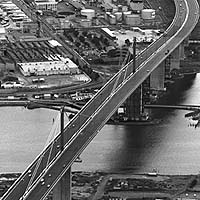
      West Gate Bridge
      Source: National Archives of Australia
       On 29 January 2009, 4-year-old Darcey Freeman died after being dropped 58m from Melbourne's West Gate Bridge. A lengthy police investigation, prosecution preparation and trial led to the conviction of Arthur Phillip Freeman of murder. He had been involved in a custody battle with his former wife, and, shortly before Darcey was dropped from the bridge, he rang her and said "say goodbye to your children". Darcey's 6yo and 2yo brothers saw him drop Darcey from the top of the bridge. Despite being recovered by people below, Darcey later died. Arthur Phillip Freeman was sentenced to life in prison, with a 32 year non-parole period.

      In sentencing Freeman, Justice Paul Coghlan said  "Your crime is a most fundamental breach of trust and it is an attack on the institution of the family which is so dear to the community"

      Also last week, NT Coroner Greg Cavanagh criticised Northern Territory Police for their lack of investigation of the drowning of an 8yo aboriginal boy in 2009. The boy had been weighted down with rocks in his shorts, and drowned in a waterhole. The case has now been referred to the Director of Public Prosecutions after he found a crime had been committed. Police were criticised for: being too quick to dismiss the death as accidental; not protecting and keeping the rocks; not making measurements of, and photographing or keeping other physical evidence; a beer can was not tested for DNA for months after the discovery (the DNA reportedly belongs to a person on remand for child sex offences); the waterhole was not drained and searched; evidence (a pornographic magazine and a singlet) was dismissed as unimportant without being tested. The list goes on.

      Any unlawful death hurts society. The killing of a child is especially painful for family, and society. In the Melbourne, Victorian, case, police conducted an investigation which led to trial, and conviction. In the other, it is hard not to conclude that the death of an aboriginal child was deemed not worthy of rigorous investigation by the investigating police. Our society has been hurt twice by this case: once that a child has been killed; and again because the police we trust apparently did not do their job properly.

      John

      Saturday, April 02, 2011

      Carbon Tax Debate Hijacked

      The debate about whether Australia should, or should not, have a carbon tax is being hijacked. Today in Sydney there were two rallies: one in favour of a carbon tax, and one opposed to any carbon price.

      The anti-tax rally, apparently organized by on Luke Jenkins, boasted the support of 22 organizations. All were pro-conservative media (The Australian, The Daily Telegraph); conservative-media journalists (Andrew Bolt - he of the current controversy concerning his comments about some aboriginal people); political organizations (Menzies House); Jo Nova (she has links to the Heartland Institute, which worked with tobacco giant Philip Morris to try to discredit second-hand smoke as a danger to health); One Nation; ... There website is: http://www.nocarbontax.com.au/ I don't doubt that there are extremists associated with, and driving, the organization. They play on one basic human trait: we don't like paying any tax.

      Rallies are organized, and the Liberal and National Party politicians invited. It is as if the no-tax power-brokers are waving the tails of the Coalition politicians! Some of them are willing subjects, for their own political purposes.

      The pro-tax, pro-climate change rally was organized by GetUp! - http://www.getup.org.au/ - an organization also known to contain some extremists, and willing to criticise all and sundry that don't meet their "social" wishes, including the Labor Party. Like the No carbon Tax group, they attempt to wag the tail of politicians and political parties.

      Both rallies are reported to have had about 4000 participants.

      So, should we have a carbon tax?? Yes ... and No.

      Here, let me say that I think that people are contributing to rising Carbon Dioxide levels; and that increasing Carbon Dioxide levels are a cause of increasing average temperatures of the earth, rising sea levels and (likely) increasing  frequency and severity of extreme weather events. Rational argument doesn't work with climate sceptics / Conservative politics, but:
      • NASA (Oct, 2010) has a report that concludes 
      "... industrial activity is responsible for the rapidly increasing levels of atmospheric carbon dioxide and other greenhouse gases. It is not surprising then that global warming can be linked directly to the observed increase in atmospheric carbon dioxide and to human industrial activity in general."  http://www.nasa.gov/topics/earth/features/co2-temperature.html
      • If it comes down to believing the myriad Conservative media & skeptics, or Dr Karl Kruszelniki, I'm mush more inclined to believe Dr Karl

      Yes - a carbon tax would work better in a closed economy. That is, one not exposed to, and part of, world-wide economic activity. Taxes, like interest rate movements from The Reserve Bank are designed to change people's behaviour. A carbon tax will help change people's behaviour in their use of carbon-based energy: mostly electricity and petrol. This is because society needs an impulse to change its behaviour, and if people want to not pay the tax, they will change their behaviour.

      No - because Australia is part of a 'global economy', and taxes work best in a closed economy, an Emissions Trading Scheme with a capped amount of carbon pollution, or even one that reduces the levels of carbon pollution, is a better option.

      A price on carbon is appropriate, the pollution has an economic cost that polluters have not had to pay, and economics says that they should.

      John

      Tuesday, March 29, 2011

      O’Farrell Finds ‘Black Hole”

      (This post has been updated on 30-March))

      New NSW Premier, Barry O'Farrell, has released the typical new government "we found a black hole in the budget" media release.
      It was not unexpected - almost every new government does it, whether Coalition or Labor.
      Mr O'Farrell released a media statement headlining a "$4.5 Billion black hole".
      But where did the $4.5 Billion ‘black hole’ come from? The answer lies in events since the last estimates were released.

      • the last estimates were released on 15-Dec-2010 and are shown below. the ‘latest estimate’ is reportedly what was given to Mr O’Farrell. The full document is at http://www.treasury.nsw.gov.au/?a=19225 
      Budget Results

      2010-11
      $m

      2011-12
      $m

      2012-113
      $m

      2013-14
      $m

      1/2 Yearly Review
      (Dec-2010)

      167

      176

      432

      129

      Latest estimate

      204

      -405

      -1,200

      Change from 1/2 Yearly Review

      28

      -837

      -1,329

       
      Even with the updated figures the estimates give a TOTAL deficit for the period 2012-14 is estimated at $2.15 Billion, not the $4.5 billion quoted by Mr O’Farrell, which includes a new treasury guesstimate, the basis of which is  unknown. Budgets for 2011-12 – 2014-15 will be controlled by Mr O’Farrell and his Treasurer, expected to be Mike Baird.
      • The estimates only go to 2013-14, BUT … there’s always a ‘but’ … Mr O’Farrell has included a guestimate for 2014-15, not included in the forward estimates by Treasury. The ABC reported
      … Claire Curtin from Standard and Poor's says there is no threat to the state's credit rating at this stage.
      "A significant proportion of the $4.5 billion number is both outside our outlook horizon and the forward estimates period," Ms Curtin said. …
      • The new budget report will account for the ‘worst-case’ – it’s what Treasury does for incoming governments.
      • It also accounts for the result of Labor’s sale of publicly-owned electricity assets, the extra expenditure involved, including developing a coal mine for a private company, and the subsequent loss of income from them. Former Labor Treasurer, Eric Roozendaal, is responsible for that.
      All up – I do not doubt there is a hole in the budget, but I am not sure it’s a big as BOF said.

      Perhaps, in the spirit of new ‘accountability’ promised by Mr O’Farrell, he might release the basis of his budget deficit in 2014-15, approximately 42.4 Billion, by his reckoning. Everyone’s allowed one dream per day – I guess I just had mine.

      John

      Sunday, March 27, 2011

      Liberals to Rule NSW

      Yesterday's election saw the Liberal-National Parties win government in NSW. The Labor Party (ALP) has governed for 16 years. Barry O'Farrell will be the new Premier of NSW. Outgoing Labor Premier, Kristina Keneally, conceded defeat and congratulated Mr O'Farrell last night.

      The result has been largely a foregone conclusion. Even before the election campaigning started, polling showed that voters had deserted the ALP. The following table shows 2-Party-Preferred voting intentions of NSW people surveyed from Dec-Jan to March this year.

      Month
      ALP
      Coalition
      Dec - Jan
      39%
      61%
      Jan-Feb
      38%
      62%
      March
      37%
      63%
      The figures I saw last night indicated an approximate distribution of 36% ALP and 64% Coalition
      Newspoll (http://www.newspoll.com.au/) states that:
      These surveys were conducted on the telephone by trained interviewers among voters throughout New South Wales. Telephone numbers and the person within the household were selected at random. The data has been weighted to reflect the population distribution of New South Wales. The latest survey is based on 1,000 interviews among voters. The maximum margin of sampling error is plus or minus 3.1 percentage points
      That means that, despite a small difference in actual numbers, the polls have essentially showed no statistical change between January and polling day. This means that the election result was not influenced by either leader, nor by their party advertising. Any claims by the Coalition that its campaign advertising about a carbon tax influencing the result will be, at best, ‘spin’. Spin really refers to political false advertising.

      The Coalition, as of this morning, expects to have 66 of 93 seats. Of those 66 seats, 17 are held by the National Party; 49 by the Liberal Party. The Liberal Party could govern in their own right. It remains to be seen how much ‘weight’ they will throw around in the joint party room on Monday morning!

      Kristina Keneally has indicated she will not stand for the leadership of the ALP in Opposition, saying she believed the new leader should be unencumbered with decisions of the past. Policy and decisions have been made by a few, with their political interests being the driving force. With as few as 19 or 20 Members of the Legislative Assembly, and no new members, the ranks of potential leaders are thin. They include:
      • John Robertson, who moved from the Legislative Council (LC) to the Legislative Assembly (LA). He has been the most widely mentioned in the media. He has “baggage”. As representative of Unions NSW, he vigorously, and vociferously, opposed the sale of NSW electricity assets. He was ‘given’ a seat in the LC by the ALP party machine, then promoted to Minister for Transport. Suddenly, his opposition to the sale of our (people-owned) electricity asset wasn’t a problem, and he kept quiet during the sale. As Minister for Transport, he oversaw what many voters believed were myriad problems: ferries, trains, busses.  At best, he will be a party-machine installed stop-gap, who could kick heads. He will not kick heads in the party machine, although that is what is required! after all, they will largely be responsible for the politicking that might well install him as leader. John Robertson has baggage, will likely remain unpopular with voters, and will not win an election.
      • Carmel Tebbutt, former Deputy Premier and Minister for Health. She carries less baggage than John Robertson, but hospitals are still a problem area for voters, and she might not have the backroom influence or power that John Robertson is likely to have. This, incidentally, was one of the perceptions about Kristina Keneally. Being personable, hard-working , logical and caring doesn’t count in the current NSW Labor machine, even if those qualities are recognised by voters.  Being from the left faction, Carmel Tebbutt will not be popular with the right-wing party machine.
      • Nathan Rees: – ‘been there, done that’, and was not popular with voters, nor with the right-wing of the ALP.
      The Coalition will expect to rule NSW for at least 8 years (2 x 4-year fixed terms). It will likely take that long for the NSW ALP to purge the party machine, give more say to rank and file members, and rebuild policies based on the interests of the people of NSW, rather than the interests of some party power-brokers.

      John
      PS expect the budget in late May 2011 to 'slash and burn', especially the Public Service, a traditional target for incoming governments, with only token trinkets for some newly won seats in western / south-western Sydney and, perhaps, one or two big-ticket schemes to be announced, but not funded, and with no delivery in 2011-12.

      Sunday, March 20, 2011

      Incoming NSW Government Tasks

      Sometime next Saturday, 26-March, many expect there will be a new NSW Government, one led by Barry O’Farrell of the Liberal Party. the National Party will his Coalition partners in government. As a voter, I have a list of things that will need his urgent attention. These tasks will help prevent members of his government behaving in ways about which he, the media, and many voters have been critical.  I believe that whoever wins government, Barry O’Farrell, or Labor’s Kristina Keneally must:
      
      KristinaKeneally
      Kristina Keneally
      
        
        BarryO'Farrell
        Barry O'Farrell
        
      1. Remove Ministerial discretion in planning matters. Current legislation gives the Planning Minister the opportunity for personal discretion, and provides an atmosphere, and fosters a culture where, decisions that would otherwise be deemed unethical or corrupt are allowed; even encouraged, by relationships with other politicians, lobbyists, and developers. Witness, for example, the spate of approvals given by Tony Kelly in the day before the government went into caretaker mode. Most of those decisions concerned the development at Barangaroo, to the benefit of Lend Lease. One of those allows Lend Lease to develop a car park without having to remove toxic chemicals from the ground. Legal? Aapparently. Ethical? ?
      2. Ensure ethical standards. All other sections of the “public service” are bound by ethical standards and Codes of Conduct, but apparently, politicians are not. The current Parliamentary Standing Committee on Ethics is toothless. It can do nothing to reprimand, nor take any action against, any MP who acts unethically.  Indeed, there appears to be no Code of Conduct which explicitly outlines expected and prohibited behaviours of Parliamentarians. That means, provided a NSW Parliamentarian does nothing illegal, they cannot be found to be corrupt, regardless of how unethical their conduct might be perceived.
      3. Restore political neutrality to the Public Service Senior Executive Service. The current SES has a number of people, including Directors-General, whose appointments are perceived as tainted by political connections. Not all, but some of them. It is likely their contracts will be either terminated, or not renewed. The incoming Premier must act ethically,and disallow the practice that has politicised the public service, solely to give Ministers a highly-paid “Yes, Minister” underling. Any political appointments hinder free, but honest advice, and degrade our democracy.
      4. Restore the esteem of our social infrastructure. Public Schools, Public Hospitals, Public transport, TAFE, Community Services all need to be promoted, and seen to be valued by Government. Only then will the public’s esteem grow.
      5. Restore Standards of Question Time Behaviour. People call our Parliament “the Bear Pit”. Many don’t respect Parliament, nor the politicians that give it the bad name. Enough said.
      6. Retain Public Assets in Public hands.  Public School land is not, for example, an asset to be sold to developers, or to private schools. It would be sensible, and appropriate, for example, to include a caveat excluding public school land sold to private entities being used for educational purposes.  (see also Points 1, 2 and 4 above)
      If all the above sounds fine, but terribly idealistic, even naive, then think about this:
      “If you don’t aim to hit the bullseye, you’ve got no chance”

      Let’s annoy and harangue our politicians and leaders till they do what the ought to do.


      John

      Tuesday, March 15, 2011

      NSW Ethics Shmethics

      The last Liberal-National government in NSW was led by Nick Greiner. In 1992 the Independent Commission Against Corruption (ICAC), which he established, found him to have acted corruptly. This was later overturned in the courts, because what he did in offering Terry Metherell a senior Public Service position was not illegal, and there were no ethical standards for politicians.

      Ian Temby found Premier Nick Greiner had acted corruptly. Greiner had offered a place to Terry Metherell with the purpose of removing him from Parliament to the advantage of the governing party. Eventually, the courts found in Greiner's favour. The court's reasoning was that Greiner had not acted illegally. The sole basis for a finding of corruption was, therefore, if he had breached a code of behaviour by which he was bound. The courts found that, although public servants and other officials were bound by well established codes of behaviour, politicians were subject to none of them. In effect, unless they break the law, politicians can’t be corrupt in NSW because they have no ethics.” (Chis Hurley, 2004) http://www.infotech.monash.edu.au/research/groups/rcrg/publications/0406rmethicsch.pdf

      The irony was that Nick Greiner had campaigned partly on the alleged corruption of the previous, Labor, NSW Government, led by Neville Wran.


      NSW voters, individually and collectively, have a good sense of what is right and wrong. Many see the last-minute changes to regulations by Planning Minster Tony Kelly, to the benefit of Lend Lease, as being unethical, even if not unlawful. So, too, the allegations of document shredding by Labor Ministers and staff will be seen by many as corrupt. It has been reported that current Labor Premier, Kristina Kenneally, has ordered the destruction of “thousands” of potentially damaging sensitive documents, and that she “expect(s) all public servants, be they in the bureaucracy or government advisers, to be following that direction” 

       http://www.news.com.au/breaking-news/greens-concerned-at-labor-shredding-documents-before-nsw-election/story-e6frfku0-1226020642333#ixzz1GezirtsZ


      There is a NSW Parliamentary Ethics Committee. The NSW Parliament website says:

      “This Committee has the function of carrying out educative work in relation to ethical standards applying to Members of the Legislative Assembly as well as providing advice on the standards. The Committee can also consider matters of privilege referred by the House.”

      However, the Committee can not take any action against any member, even if the member is deemed to have acted unethically! It is toothless.


      Many people believe political ethics have taken a beating under the current Labor Government. But will an incoming Liberal-National government change the rules if those rules mean its own members & Ministers must adhere to a set of standards not previously achieved in NSW? Remember, too, that elements within the Liberal Party are opposed to ethics classes in NSW public schools.


      Will anything change? Ethics, Shmethics, if you ask me.


      John

      Sunday, March 06, 2011

      Carbon Costs

      Let’s be clear: All our political parties, The Greens, Labor, Liberal and National Parties believe climate change is occurring. This is despite Tony Abbott’s well-publicised comment about the science  being “crap”, and despite some nay-sayers. Most of the nay-sayers are from the Liberal & National Parties. It is a politically convenient position, allowing big-polluting supporters to continue to pollute.

      What IS different is the politics. The Liberal & National Parties have abandoned the policy of an Emissions Trading Scheme (ETS) their former leader & PM, John Howard. Labor, having promised action on climate change under Kevin Rudd, and now Julia Gillard, have been unable to resolve the details of ETS to satisfy the Greens and Independent MP’s & Senators. The result is a proposed interim carbon tax, to be replaced by an ETS in 3-5 years. So, how do the policies compare?
      The Greens (main points)
      • binding national emissions targets for 2012, 2020 & 2050, with a 40% reduction on 1990 levels by 2020
        • detailed strategy to reduce emissions from energy, transport,  industry, waste & land management
      • future energy needs to be met by sustainable, renewable energy sources
      • an equitable transition to a low carbon economy through a range of market-based and regulatory mechanisms reflecting the real costs of greenhouse gas emissions
      • address the social impacts of the transition to a low carbon economy
      • establish a national system of energy efficiency targets
      See: http://greens.org.au/policies/climate-change-and-energy/climate-change-and-energy

      Labor Party (current policy)
      • 5%-15%  reduction on 2000 carbon dioxide emissions by 2020
      • carbon tax (details to be advised), with a transition to an ETS in 3-5 years.
      • “businesses with the highest levels of pollution will have a very strong incentive to reduce their pollution.”
      • “The Government will then use every cent raised to:
        • Assist families with household bills
        • Help businesses make the transition to a clean energy economy
        • Tackle climate change”
      See: http://www.alp.org.au/agenda/environment/carbon-price-mechanism/

      The Coalition (Liberal / National Parties)
      • 5% reduction on 2000 carbon dioxide emissions by 2020
      • “direct action” involving:
        • an Emissions Reduction Fund (funded by taxpayers)
        • “incentives” for businesses
        • penalties for businesses that pollute beyond “business as usual levels”. Penalties to be set “in consultation with industry”.
        • plant trees, but not on useful land for farms
        • solar & biofuels
      See: http://www.liberal.org.au/~/media/Files/Policies%20and%20Media/Environment/The%20Coalitions%20Direct%20Action%20Plan%20Policy.ashx

      Comments:
      1. policies from Labor and Liberal-National Parties have been subject to change to suit particular political climates at the time.
      2. the economics of a carbon price are complex.
        1. Electricity use might be more economically “elastic” than previously thought. See http://www.theage.com.au/opinion/society-and-culture/conspicuous-conservation-means-less-is-much-more-cool-20110118-19v75.html People in Sydney have REDUCED their “average electricity consumption in Sydney fell by 6 per cent between 2005-06 and 2009-10”, while the price increased by 50%
        2. Petrol, though, seems to be rather “inelastic”. That is, people will continue to buy, almost regardless of the price. But they can exert significant political resistance. remember, John Howard reduced the tax on petrol after it first hit the $1/litre mark because of the political backlash from motorists. He couldn’t, and wouldn’t, continue to reduce it, though,and petrol is well over $1/lire now.
        3. Taxes, including a carbon tax or ETS, are designed to force a change in people’s behaviour. Think of the effect of increasing interest rates on household spending – the effect is similar if people pay more tax.
      3. Consumers will pay one way or another: a carbon tax / ETS means they will pay pay as they use, and change behaviour accordingly; an Emissions Reduction Fund means they will pay through other taxes, and will not associate the (mostly income) tax with carbon pollution.
      Summary
      The Greens Labor Liberal / National
      Quality / Idealness
      9 / 10
      6 / 10
      5 / 10
      Practicality
      5 / 10
      5 / 10
      6 / 10
      Effectiveness
      8 / 10
      6 /10
      4 /10
      Cost to Energy Consumers
      Very High
      High – via “cost”
      High – via tax

      Whatever the politicians do, I believe we should all strive to reduce our carbon emissions. We should do so because it is a good thing to do, because it will reduce the rate of increase in our costs, and because it will improve our environment.

      See also: http://www.thepoliticalsword.com/post/2011/03/07/Tony-Abbott%E2%80%99s-Great-Big-New-Tax.aspx 
      John

      Thursday, February 24, 2011

      Climate Change Compromised

      Compromise usually means that no one gets what they want, and the compromise is accepted by all because they realise that no one is completely happy, but everybody got something.

       
      So it is with today's announcement that, from July 2012, there will be a fixed price on carbon (pollution), with an eventual move to an Emissions Trading Scheme in about 3 years. (2015) Business, especially big business, wanted, and lobbied both Coalition & Labor Governments for it. Then Labor PM Kevin Rudd acceded to this, and former Coalition Minister and then Leader of the Opposition, Malcolm Turnbull, supported it. The right wing of the Liberal Party shafted him, and installed Tony Abbott as Leader of the Opposition. Abbott promptly labelled climate change as 'crap', in direct opposition to Australia's Chief Scientist, and the CSIRO.

       
      Last year's Federal election resulted in a hung Parliament, and Julia Gillard only became Australia's current Labor Prime Minister after gaining the support of Independent MP's. The result included a multi-party Committee on Climate Change. The Committee members are listed at http://www.climatechange.gov.au/en/government/initiatives/multi-party-committee/members.aspx Prime Minister Gillard Chairs the Committee. No Coalition members are listed, although the Coalition was invited to nominate 2 members of the Committee.

      The compromise reached by the Committee is a fixed price on carbon for 3 years, then a transition to an ETS. All parties have compromised:
      • The Greens wanted an ETS, including on-farm activities.
      • Rob Oakeshott and Tony Windsor wanted an ETS, not including on-farm activities. They represent rural and regional voters.
      • Labor wanted an ETS, but different from that, and it had twice lost a vote in Parliament.
      So, all parties wanted an ETS, except the Coalition which chose not to have members on the Committee. However, none could agree on the form of the ETS. Hence, a compromise, fixed-price on carbon, that shows they want to do something about climate change, but none have got what they really wanted. If it is introduced, I hope that imported goods are also subject to it, including the carbon-cost of transport to Australia. Otherwise, companies manufacturing in Australia will be further disadvantaged.

      Politics is sometimes defined as 'the art of comprommise', but it seems to me that it often compromises good public policy.

      John

      Saturday, February 12, 2011

      Healthy Change From Gillard

      Prime Minister Julia Gillard has announced proposed changes to the Health Funding agreement to be discussed, and possibly agreed, at the COAG meeting on Sunday.

      The proposed changes include:
      • Dropping the proposed loss of 30% of GST to the Federal Government. Ms Gillard referred to it as a "merry-go-round of GST money". It was to be used to raise the Federal Government's funding from 40% to 60% of health funding.
      • the proposal for the Federal Government to fund 100% of out of hospital health services.
      • direct funding of hospitals has gone. This is a good thing, I think. Direct funding by bodies under the control of a Prime Minister, Premier, or Minister removes some transparency, and allows for politically-driven funding. Think WorkChoices, where the independent Industrial relations Commission was disbanded, and a federal pay authority established under the effective control of former Prime Minister John Howard.
      • The Federal Government will commit to funding 50% of future increases in health funding, subject to "performance targets" being met. This is less than the 60% under the previous model, and indicates to the states, especially those led by Liberal Party Premiers, that the cost of retaining control over all their GST is that the Federal Government will commit less.
      • Funding will be paid by Federal & state governments to a new Health authority, to be independent of Federal & state government interference, similar to the Reserve Bank. This is a much improved policy to the direct funding model previously proposed by Kevin Rudd.
      The changes are largely politically driven to gain the approval of states which have a Liberal Party Premier, including Barry O'Farrell who is expected to be NSW Premier after the 24-March election. Politics is, after all, the art of compromise.

      Liberal Opposition Leader Tony Abbott has, predictably criticised the changes, calling them "the biggest backdown since the surrender of Singapore" (in WW2). Abbott has a history of criticising absolutely everything from the Federal Government, so his comments are no surprise.

      It was disappointing that no journalist, not one, asked Abbott the following questions:
      • Mr Abbott is this new proposed policy 'bad policy'? [Abbott would have effectively answered 'Yes']
      • If it is such bad policy, why will 2 Liberal Premiers, and one Premier-in-waiting, agree to it?
      Also disappointing was that no journalist asked Ms Gillard:
      • Ms Gillard wasn't the direct funding model, proposed by former PM Kevin Rudd just bad policy, because it opens the possibility of future governments funding hospitals for their own political ends, and isn't it better that state governments be given a pool of funds to allocate to hospitals through their Health Departments? [this would have been awkward, because it would require criticism of Kevin Rudd's proposals, something she was at pains to try to avoid]
      • GST revenue to states will fall during some future economic downturn. How will health funding be affected by future economic downturns, given that the states use GST money to partly fund health?
        John

      Thursday, February 03, 2011

      Abbott's Levy Too Far

      Tony Abbott has sent an email to Liberal Party supporters, at the end of which he asks for a donation to fight the (proposed) flood levy. It will really be a short-term addition to the rate of Medicare Levy. Both sides are playing politics with this.

      The email bears Tony Abbott's signature, and will have been approved by him, but would have been sent by a political staffer.

      Notwithstanding the words of the email, Tony Abbott has no bipartisan cooperation in mind, and has, indeed, been pressuring the Independent MP's to support him and bring down the government.

      The post script plea for donations to campaign against flood levy is rather tacky in its implication. That is, that there should be no levy, and perhaps that taxpayers should be more self-centred and contribute less to society. It is Liberal Party philosophy that "user pays" ... unless there is political capital to be made for them.

      Abbott's plea seems to be backfiring. It seems that some older members/supporters of the Liberal Party actually think using an income tax levy to rebuild infrastructure is entirely appropriate, and Tony Abbott risks alienating not only Liberal supporters who hold such beliefs, but many Queenslanders, too. Queensland is a state vital to both parties' electoral success.

      For its part, members of the current Labor government have hit the media with criticism of the email, again for purely to score political points. Abbott tried to laugh it off, saying he believes Labor emails also solicit donations. But it's what he doesn't say that's important here - that Labor has not asked for donations to fund ads opposing a mechanism to rebuild infrastructure after a natural disaster. It was just tacky and rather cheap politics by Tony Abbott & the Liberal Party. So is the "point-scoring" by Labor.

      John

      Saturday, January 29, 2011

      The Politics Of Rebuilding

      This week saw a return to normal partisan politics.

      Having flown the kite in the media, Prime Minister Julia Gillard announced the proposed addition to the Medicare levy to fund the reconstruction of public infrastructure, especially in Queensland. The levy will fund about 30% of the reconstruction and will be collected for only 1 year. It will levy an extra 0.5% of income over $50000 and less than $100000; and 1%  for incomes over $100000. You can see the proposed weekly effect at http://www.smh.com.au/business/how-the-flood-levy-will-affect-you-20110127-1a69i.html 

      Politically, Julia Gillard wants to ensure the budget surplus as promised in 2012-13. It will be her first surplus, with the previous and current Labor Government having rightly gone into deficit to ensure Australia did not slide in recession during the Global Financial Crisis, but she also needs to prove wrong Tony Abbott's assertion that Labor would never deliver a budget surplus. Never mind the extenuating global financial and exceptional flood-induced circumstances.

      Meanwhile, Opposition Leader Tony Abbott and Shadow Treasurer Joe Hockey have been relentlessly pursuing the "great big new tax" line in as many 5-second media grabs as possible, rather like Chicken Little's "the sky is falling, the sky is falling". His solution to finding the extra money is to cut government programs and other spending. Again, for political purposes, he suggests dumping the National Broadband Network. This is despite his alternative plan from the election being generally regarded as slower, and creating more congestion in the Internet wireless bandwidth.

      Tony Abbott and Joe Hockey have been critical of the levy, because it's an income tax levy. But they supported the levies introduced and imposed by former Liberal Prime Minister John Howard: the gun buy-back levy after the Port Arthur massacre, and the airline flight levy to pay employee entitlements after Ansett went broke. They also both proposed an income tax levy to fund a paid parental leave scheme at the 2010 election. A levy on income tax is not a philosophical problem for them; the problem is that they are not in government, and they therefore see the need to whinge about it.

      Meanwhile Abbott has also applied political pressure to the Independent MP's, with whose support Julia Gillard remains Prime Minister. There's nothing "bipartisan" about that, despite any public comments to the contrary by him.

      Tony Abbott's negative politics, which reinforces the selfish "why should I pay more" and "I already donated to the flood relief" attitudes will be a challenge for Gillard, and Treasurer Wayne Swan, to overcome. We have just celebrated Australia Day, and given ourselves a pat on the back for wanting to help our society. To now whinge about a 1-year small levy to help rebuild our flood-ravaged physical and social infrastructure is, perhaps, hypocritical, selfish, and not the kind of Australian we say we want to be.

      John